
Friday, December 29, 2006

Something you don't see every day

But I do. It's a row of beer and whiskey joints (맥주 양주 점 in Korean). Typically found in lower middle class residential areas, this is a kind of bar where you pay exorbitant amounts of money for beer or whiskey, which you share with hostesses who are typically middle-aged housewives looking for extra cash. You can go ahead and touch them as much as you like. Many of the women will subsequently sell themselves in the shabby by-the-hour hotels which are never more than a drunken stumble away. It's all super classy. One of the major factors driving the industry is the fact that these women need the money to send their children to after school classes. Because the Korean education system is basically in the middle of a death spiral, parents send their children to private classes all day. This is how I make my living. Here's a few more pictures (I've got a bunch):
This one is called "Amazon", presumably after the one-breasted warrior women who periodically joylessly raped their men-folk and exposed their male babies on the frosty steppes of Eurasia.

This one's called "Sujin's Place". 'Sujin' is the Korean name equivalent of 'Brandy' or 'Trixie', I suppose.
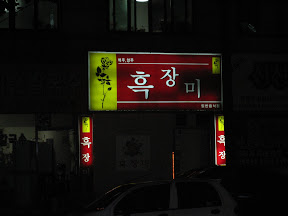
Here's "The Black Rose". This is where you can fondle middle-aged Korean Suicide Girls.
Incidentally, all these pictures were taken within a two minute walk of my parent-in-law's house. Not that they live in a bad neighborhood. Korea didn't use to be too big on zoning laws, so in these older neighborhoods you've got residential buildings, stores, placed of prostitution and manufacturing facilities smooshed together in a sort of harmony that wouldn't be very nice to listen to. What is the reaction of the typical Korean to the preponderance of prostitution in their neighborhoods? Willful ignorance. They totally ignore the bars' presence, like they're not even there.
I think we Americans could learn something from that.

Pictures

Tonight I took some time out of my recently de-busied schedule to sit down and look at the various things that Google is offering up for free, and I found that Picasa, the photo organizer, now features a very easy to use, free web album service. So I've posted a lot of photos on it. The other nice thing about Picasa is that there is a blogger "Blog it!" button too. Naturally, no single one of my photos is blogworthy. Actually let me take another look.

Wednesday, December 27, 2006

Koreans taking over the black hair industry

Check out this documentary about Koreans invading the black hair industry. Hard-working Korean immigrants are the bad guys in this movie. But not exactly because they are all given a chance to explain themselves. And many of the black business owners that they are edging out of the business express respect at their hard work and solidarity that allowed them to corner the market. Also many of the black business owners place a substantial amount of (in some cases total) blame on themselves for leaving their industry vulnerable to invasion. But in a recent edition of the NPR News & Notes Roundtable, director Aron Ranen made it pretty clear that he wants the Koreans out of the business, out of black neighborhoods, and he feels that boycotts are the best way to acheive this goal. Check it out for yourself.


Part 2, Part 3, Part 4

I found myself personally conflicted while watching the film, because I had first heard of it while listening to Ranen on NPR, calling for boycotts and asking the Korean American owner of a beauty shop in LA if he really thinks Koreans would shop at a black-owned store if the products were cheaper. His implication, obviously, being that Koreans stick together and that this is a nefarious thing to do, while he himself is calling for a sweeping boycott of Korean-owned stores.
So holding that image of Ranen in my mind, I found myself surprised that the documentary was relatively balanced. One thing that Ranen consistently and perhaps unintentionally exposed was the fact that the residents of the communities in question held no particular allegiance to black-owned stores, while black store owners seemed fairly split between the "This is our own fault." camp and the "This is a cunning conspiracy." camp. The film is devoid of any serious racism on either side, with the exception of a (fake sounding) story from one black beauty shop owner who attempted to buy a product from a Korean store owner wholesale only to be told that the Koreans were "keeping the niggers out of the business" or some such. Watch the movie and see for yourself, the scene both doesn't ring true and doesn't jbe with the general tone of the movie.
One of the positive results of the movie was that the Black Owned Beauty Shop Association (or BOBSA) was formed. The film ends on a positive note, with a BOBSA meeting at which one man speaks seriously about mobilizing the community for a boycott, but the woman who gets the last word sums up the situation. The Koreans knew that they couldn't take on Revlon and Paul Mitchell and the other white hair care companies, so they took on the smaller and less organized black hair care industry, and they succeeded. Now it is time for the black businessmen to step up their game to take on the challenge from Koreans before they lose it all.
Writing the last paragraph, one question arises. The film repeatedly mentions that black hair care makes up a disproportionately large portion of the hair care industry as a whole. Shouldn't it have therefore attracted or resulted in bigger, better organized companies in the first place? Why was the black hair care industry so vulnerable? Ranen in the NPR piece states that the Koreans vertically integrated the black hair care industry, so could it just be that the beauty parlor industry itself was easier to infiltrate?

Monday, December 25, 2006

Saturday, December 23, 2006

Hagiography for Ban Ki-moon

My computer has crashed twice while trying to write this, and I think the Korean CIA is doing it, so I'll keep it short and sweet. check out this article from The New York Times that tries to make Korea out as some sort of mystical land where tradition and modernism meet, and remember that Korean traditional culture was effectively destroyed by the Japanese during the colonial era, and what's is left now is whatever is useful to the government in stirring up irrational nationalism to distract people from the nation's real problems, like an education system fit to collapse. Read this and know that every time the article mentions ancient traditions, feng shui, ginseng farming and prophecies, the real life of almost all Koreans consists of watching TV, listening to soulless pop music, talking on their cell phones and hanging around department stores. Basically, every time the article says 'feng shui master', think 'civil war buff'. and when it says '22,000 practitioners of feng shui, or pungsu in Korean, as well as a few Buddhists' think '2,000 senior citizens on group tours to see Ban Ki-moon's home town, drink sweet potato liquor and buy chestnuts from farm stands, as well as a few fervent nationalists looking to fervor it up'.

Friday, December 22, 2006

My stars and garters

I went to an astrologer with my wife, mother-in-law, sister-in-law and her husband tonight. I am a hard core skeptic and expected to be cold read and told what I wanted to hear, subconsciously or otherwise. Nonetheless I was inspired by the words of Richard Wiseman in his interview on the Skeptic's Guide to the Universe Podcast. Dr. Wiseman explained that one should not close themself off to a realm of human experience just because they know it's not real or true. He also suggested that going to astrologers, whether you believe it or not, has a positive affect on one's mental state because the mind functions better in the absence of unknowing about the future, even if the "knowledge" one has is based on nothing. I have been experiencing some anxiety of late about my future and thought it might help.
So I went and watched a master at work. Korean astrology is interesting. Her technique reminded me of John Edwards. She mixed things she knew from knowing my mother-in-law from the neighborhood , things she could easily see, and logical answers to straightforward questions and mixed them together. She noticed me rubbing my neck during my sister-in-law's reading and later told me that I have to be careful about my neck. She saw my size and told me (when I asked) that I won't get cancer or have a stroke but my heart is weak and I have to be careful and exercise. She even name-dropped trans-fats ('you know, the foreigners eat a lot of trans-fats, so . . . '). I decided to ask her a lot of questions and see what she'd say. Accordng to her I'll get into the grad school of my choice and move to America, where Miyoung will live a hard life but become rich eventually. My career will be very successful but I must never start my own business. Questions about starting one's own business seem to be a big part of what she does, as she ran down the chances of success as a small business owner of everyone in my wife's family. I'm going to have two kids, and Miyoung is going to be a devoted parent (literally saying she would "donate her body" to her children). We will spend our lives going back and forth between our two countries.
Her biggest failure was when I asked about my immediate job situation. I didn't mention that just last night I found out that my school is changing ownership and I'm going to lose the big perk, a huge free apartment next door to the school. She said that I had gone through a lot of hardships and tough times at work in the last year (I hadn't), but that next year I will make a lot more money (almost certainly impossible) and have a smoother year (also not likely).
Her biggest success was when, out of the blue, she said "You have weak bronchial tubes". I have a history of chronic bronchitis, but I hadn't had it for at least 5 years until about two weeks ago. Nonetheless, I am fully recovered and there is nothing about me that says 'weak bronchial tubes'. To put it into perspective, I just learned this word in Korean when I got bronchitis. Bronchitis is not a well-known condition in Korea and people generally don't speak in that kind of doctory way that we Americans do. I was really surprised to hear that bit. Now note that I'm not saying she figured that out through some supernatural means, but I must concede that I have no clue how she did figure it out.
For all you rationalists out there, I highly recommend going to an astrologer and seeing what your future holds. It is fascinating to watch a career manipulator at work, especially when you can stand back and catch a glimpse behind the curtains at what she's really doing. And I'll tell you honestly that just because some old lady that I never met before told me that I'll get into the grad school that I want to get into, I feel somehow much better about the future.

What Christmas means to me

When I read Salon I get the sense that there are a lot of liberals out there who are rational and agnostic, to say the least, and they feel some sort of spiritual emptiness because they don't believe in God and don't raise their children in a religion. These people tend to replace belief in God with the belief in a lot of spiritual mystic hooey. I recently found that, while I still really really don't believe in God and I don't feel any spiritual emptiness at all, I did feel that I was closing off a whole literary and philosophical realm that has fed into Western Civilization for a long long time by pooh-poohing religion. I've always felt that a lot of the rationalist, secular humanist skeptics out there think science and reason are enough to live on, but there's a vital moral and humanistic element that you completely miss out on if that's your only focus. People seem especially to avoid Jesus if they don't believe in God, but I think that's mostly trying to set themselves apart from the religious types they feel so superior to. With all that in mind, I sat down and I really thought about what Christmas means.
The first thing that never occurred to me before about Jesus is that he seems to be uniquely a middle class prophet. His family owned their own business, their own tools, and his father was descended from King David. and yet by this sort of accident of history he winds up being born in a cow shed among animals, far from his home. Imagine what it would feel like to have your baby in a stable. That made me really feel for Mary and Joseph. It also reminded me greatly of Eddie Albert's character on Green Acres, who was born in a small Mid-Western town to sophisticated New York socialites on the way to the West Coast, and later decided it was his destiny to become a farmer. I could see how that kind of birth could lead Jesus to be concerned for the lowliest of society when he himself was pretty well-off. It also bears a resemblance to the life of Teddy Roosevelt, who was a wealthy socialite who postured himself as a hard charging tough guy soldier and populist and built his image on a sort of puffed up hard-luck story about having asthma. Not that I think Mary and Joseph were socialites, but neither were they paupers. Plus don't forget Jesus' cousin was an influential prophet in his own right, so his family certainly had some standing.
The aspect of the nativity story that I like the most and that no one ever focuses on is the baby-as-metaphor-for-the-potential-of-life. Jesus as a baby is us as babies, always depicted as soft and mild and peaceful, and yet some day he will essentially bring the concept of selflessness and putting yourself in another's shoes to the world at large, which will inform western civ to no end. Jesus told people to think about what other people feel, and that in turn gave birth to all sorts of great things, like psychology and good literature and the ASPCA and charity in many of its forms and Battlestar Galactica. I contend that none of those things would be quite the same without Jesus, and that, as it sort of says in the song "Oh Holy Night", the world just sort of chugs along its own disgustingly selfish and self-interested path wherever Jesus' teachings don't reach. Make no mistake, human beings are prone to all sorts of despicable behavior, like selling their own children and enslaving others, and Jesus is pretty categorically against all that stuff and gives it a framework in which that opposition can gain some strength. Here in Korea, people used to chain their children up on the edge of town if they couldn't afford to feed them, and people still throw their kids out the window and jump after them when they face financial hardships, apparently unable or unwilling to imagine their children living on without them. And then there's the more simple stuff, like walking feelinglessly past people suffering, whether they be the poor or old men who've fallen down drunk.
So there is this baby, who really could have been anything, but he chose to become a preacher and then eventually to perhaps claim he was God, but along the way lay out a completely new moral code that still permeates thought in many of the world's nations and is, to me, undoubtedly a good thing, despite all the crusades and persecution and wars and Sufjan Stevens that come with it.
So I say happy birthday Jesus. Thanks for the soul.