Friday, October 26, 2007

Korean phonotactics and American English

I've occasionally wondered to myself at the process by with the Korean letter shieot (ㅅ) can be pronounced like a breathier version of an English s (삽 - sap - shovel), like an English sh (실 - shil - thread), like the t at the end of an English word (것 - geot - a thing) or like an English n (씻는다 - sshinneunda. This is because of the various rounds of sound changes that happen between the assembly of a Korean word and it's actual utterance. In the following examples, the capital letters represent the original or base pronunciation of the Korean letters (the phonemes); the lowercase letters represent the actual sounds produced.

  1. 삽 - SAB (shovel) >final consonant devoicing of B to p > sap

  2. 실 - SIL (thread) >S becomes sh before I and Y> shil

  3. 것 - GEOS (thing) > S becomes t at the end of a syllable > geot

  4. 씻는다 - SSIS-NEUN-DA (washing) >SS becomes ssh before I and Y > SSHISNEUNDA > S becomes t at the end of a syllable > SSHIT-NEUN-DA > T at the end of a syllable becomes N in front of a syllable beginning with N > sshinneunda
The first example shows the Korean letter shieot (ㅅ), which is basically pronounced like a breathy English s, coming out being pronounced like a breathy s (i.e. no overt sound change). The second to examples show shieot undergoing one sound change each, to sh and t, respectively. In the final example, the letter shieot first undergoes a sound change to t (as in example 3), and then undergoes a further change from t to n. Thus a letter which, in its most basic form is pronounced s comes to be pronounced n.

Fascinating, isn't it?

Yes, but what brings it to mind?
I recently heard two examples of spoken English that follow a similar sequence of sound changes, from s to d and from d to n.
The first one was uttered by Ginger from the reality real estate show "The Real Estate Pros".


She pronounced the word 'doesn't' as 'dudn't'.
The second example was a prisoner named Butch on an episode of This American Life entitled "Act V" who pronounces the words 'businessman' and 'business' as 'bidnessman and 'binness', respectively.
I guess the next step would be for this sound change to become generalized to similar environments. That would mean 'kiss me', 'Quiznos', 'his new business' and 'shiznit' coming to be pronounced 'kit me', Quidnos', 'hid new bidness' and of course 'shidnit'. I'll be on the lookout for this new pronunciations. If you hear any of them, be sure to let me know.

And, for those of you who don't speak Korean and those of you who've learned it and have begun to forget just what an accomplishment it is, here are a few other examples from the twisted world of Korean phonotactics.

N becomes l
  • 관리 -GWANLI (control) > N becomes l before L > gwalli

L becomes r

  • 바람 - BALAM (wind) > L becomes r between two vowels > baram
D becomes n
  • 받는다 - BAD-NEUN-DA (getting) > D becomes n in front of N > banneunda

T becomes n

  • 맡는다 - MAT-NEUN-DA (taking over) > T becomes n in front of N > banneunda
T becomes ch
  • 같이 - GAT-I (together, alike) > T becomes ch in front of I > gachi
H becomes nothing
  • 넣어 - NEOH-EO (put in) > H disappears between vowels > neoeo
B becomes p
  • 겁 - GEOB (fear) > B becomes P at the end of a syllable > geob
B becomes M
  • 겁나 - GEOB-NA (afraid) > B at the end of the syllable becomes M in front of N > geomna
GL becomes ngn
  • 격려 - GYEOG-LYEO (encourage) > G at the end of the syllable becomes ng before L > GYEONG-LYEO > L becomes n after NG > gyeongnyeo


Saturday, October 20, 2007

Newest American trend to hit Korea: calling dudes gay

This blows my mind. Effeminate Korean singer Brian from duo Fly to the Sky

goes on Gag Concert, only to be ragged on by has-been singer Lee Sang-won

for being gay. My translations are based on this article from Sports Chosun.


Lee: Where did all the talk of you cross-dressing and dating [Fly to the
Sky bandmate Eru] come from?
Brian: It's a misunderstanding due to the fact that we're so close. And sometimes I go to hang out at Eru's house and
sleep over.
Lee: [Older entertainer] Tae Jin-a always says you're so pretty . . .
Brian: Of course. I think of myself as his son.
Lee: Do you think of yourself as his son or daughter-in-law?


Lee then ordered Brian to do push-ups to prove his manhood.


Now what I want to know is where Lee Sang-won got this homophobic gay-bashing attitude from. It's one of America's most unsavory distinguishing characteristics and I've long cited its absence from Korea as a definite point in its favor (Not that it means Korea's any more enlightened about homosexuality than the U.S.)

I suspect that the audience watching Gag Concert that night was very perplexed by the attack. I mean, Korea is the land of the pink shirt, and whether or not Korean men are more in touch with their feminine side because they don't believe in the existence of Korean homosexuals, it remains true that Korean men can act in a manner that would get them brutally teased in the U.S. without fear of recrimination.

I don't know whether Lee Sang-won learned to be made insecure by other men during years of has-been exile in America or what, but I sincerely hope that his nasty sniping doesn't rub off on any impressionable Korean kids.

Monday, October 15, 2007

A super-easy Korean side dish

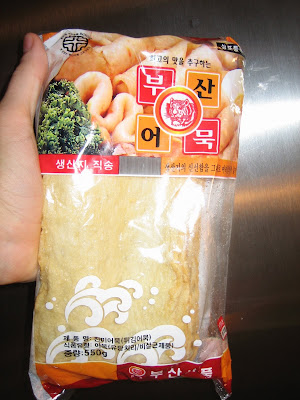
On Saturday my wife, mother and I went to Flushing, New York for my cousin's borthday. My Uncle and two cousins took us into Koreatown to go shopping. The two things Miyoung jumped at were cucumber kimchi and odeng.
Actually Eomuk. The Hanareum Mart that we went to had plenty of girls and ajummas giving out free samples, and the girl doling out the Busan Eomuk and I had a passionate discussion about the difference between odeng and eomuk and the proper English term for it. 'Is it fish paste?' Her sign said 'fish cake', which I know isn't technically correct but is much more appetizing. It seems to us that both fish paste and fish cake are misnomers, but what are the other options? Fish Roll-up? Fish sheets?
As you may well know, odeng is considered an import from Japan, while eomuk, associated most closely with Busan, is the 'original Korean article'. I would say in general eomuk is somewhat softer and spongy than odeng, but otherwise tastes the same.
Anyway, today I've got a nice easy recipe for fried odeng/eomuk.
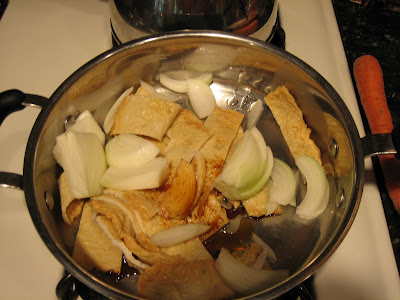
First get your nice sheets of odeng/eomuk.

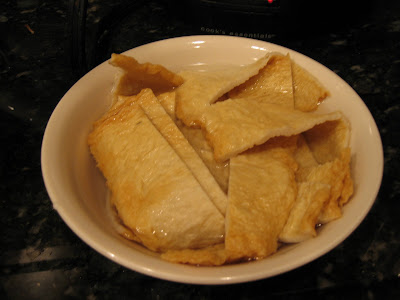
Slice it into whatever shape you like, rinse and soak it in hot water to release some of the grease and delicious saturated fat.

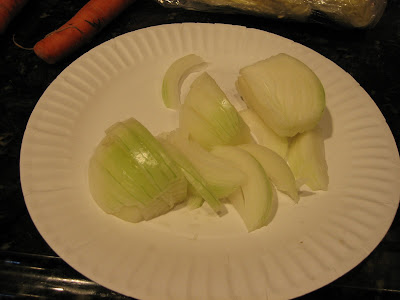
Slice up a nice onion.

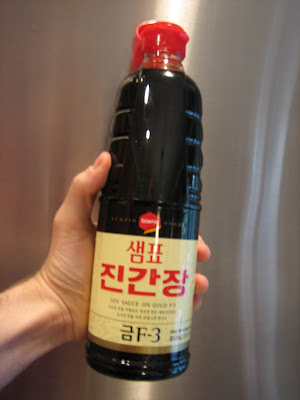
Get out your soy sauce. I recommend Korean 'Jin' Soy Sauce (진간장) You'll need about a tablespoon.

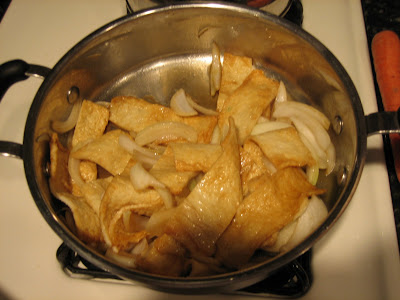
Put a tablespoon of olive oil in a frying pan and add the cut odeng/eomuk, the sliced onion, the soy sauce and about a tablespoon of sugar

Fry it up until it looks like this.

That'll last you about three days if you're Korean or, if you want to eat it American-ly, it won't be enough for one meal.
Enjoy.

Dumbest idea of the week

Thank you, Yanek Mieczkowski, Chairman of the History department at Dowling College, for exposing me to the worst analogy I've heard in a while. In his October 14th editorial for Newsday, the paper of record, entitled "Ike would not have gotten us into Iraq", Yanek compares Eisenhower's reaction to Sputnik to Bush's rection to the September 11th attacks. His thesis:
Though the Sept. 11 attacks struck America harder than Sputnik in terms of death and destruction, the aftershocks of both events were similar. How the U.S. president reacted couldn't have been more different.

I say thesis because this piece couldn't be more of a sophist, ivory tower think piece and screams "I have never had a job outside of academia."
Here is the money shot.
Despite - perhaps because of - today's war on terror, it would be easy to envision Eisenhower pushing for joint Arab-American space activities, perhaps inviting the first Muslim astronaut to fly aboard the space shuttle, while also bolstering economic ties and trade with the Middle East.

Eisenhower would have reacted to September 11th by putting Muslims in space. Why didn't we think of that?

Sunday, October 14, 2007

For those of you who know Maple Story . . .

. . . as a game for Korean elementary school kids, check out this commercial

Tuesday, October 09, 2007

Don't think of it as a commercial

Think of it as a piece of beautiful animation. Then drink some Smirnoff.

A Paint Roller moment in American identity politics

Christopher Columbus is Italian.

Like me.