Showing posts with label food porn. Show all posts

Saturday, August 11, 2007

I may never be hungry again

I wake up in the morning and, far from wanting breakfast, I steel my already full stomach for another day of eating too much. Why, you ask?
Why, because I have to go out to eat with everybody I've ever met in Korea. And since they're not going anywhere, they want to go somewhere special. I literally haven't eaten anything normal in a week. Here's a partial list of the foods I've eaten and the places I've eaten them in.

  • Grilled duck, acorn muk (jelly), and a giant octopus pancake next to a waterfall
  • spicy grilled octopus (낙지 볶음) with another giant octopus pancake
  • All you can eat tuna sashimi and a ton of beer with my brother in law
  • Giant katsu (deep fried pork, fish, and chicken cutlets) and cold spicy noodles (냉면)
  • Heaps of fancy Chinese food
  • Rice cooked in a segment of a bamboo tree with about a million side dishes
  • VIPs (buffet)
  • Blue Ocean (buffet)
  • Dijon Euro (fusion-style buffet) twice
  • About a million patbingsu (sweet bean and shaved ice treats)
  • About a million free Starbucks coffees
It's like a Twilight Zone episode. I was excited about eating a lot of special things before leaving Korea for what promises to be a long time, and yet now, when someone says "We're going out for Seolleongtang (bone soup), which I actually love, I'm like 'Is there a size smaller than children's that I can order?' Damn lamely ironic twist!

By the way, my plans for today? Lunch with friends followed by dinner and drinks with other friends. Wincing? Consider it a certainty.

Saturday, May 05, 2007

Cool Things Korean (part 5)

You know that feeling you get when you come home from a long, hard day of work and the kitchen table is covered with large, wholesale quantities of traditional Korean snack food? Yeah, that feeling. Well, I'll lay it out for you. You walk in the door and this is the sight you're greeted with.

The gigantic bags are full of roasted black beans.

The plates are covered with ssukddeok (쑥떡), which means 'mugwort rice cake' and is basically mugwort, a plant that grows wild and that is considered a weed in North America, mixed in with rice flour and, I conjecture, something sweet.

The resulting flavor is something else entirely. It strikes a great balance between sweet, gooey snackiness and herby, mediciney healthiness, and it tastes delicious.

This stuff, well, I don't know. Soy sauce and some stuff, I think.

Actually, it's soy sauce, vinegar, sesame seeds, and chives. Does a body good and goes well with pajeon. In fact the above bowl is probably enough of the stuff for 25 large pajeon.

It's nice to come home to all these things. Unfortunately all of these things have their downsides. You really have to eat the ssukddeok fast, so basically stop eating everything for a couple of days and chow down on it until it's gone or what's left has gone bad. And the beans give you unbearable, painful gas. And the soy sauce is really pretty limited use. And when you have a ton of all those things, you really have to eat them until you hate them. When I took these pictures on Monday I was salivating. It's now Saturday and I hate them all and will until I've forgotten what they taste like and they appear on my kitchen table out of the blue. The circle of life continues.

Sunday, April 29, 2007

Dakdoritang: Korea's answer to freedom fries (plus recipe)

Koreans like chicken, but they are in their hearts pork people. There aren't many good Korean chicken dishes, in fact by far the most popular chicken dish in Korea is battered fried chicken.
A distant second, the most popular traditional Korean chicken dish is samgyetang, a whole chicken stuffed with sticky rice, jujubes, gingko, and ginseng.
Samgyetang (literally 'chicken and ginseng soup') is the number one traditional Korean chicken dish, but it doesn't seem to be eaten all that often by the average Korean. That said, it is exceedingly delicious and said to have tremendous health benefits, none of which I believe in.

There's also jjimdak (steamed chicken),
which was a hugely popular fad several years ago. It is basically chicken, carrots, onions, potatoes and glass noodles in a dark soy sauce base. Most jjimdak restaurants also have the 'seafood jjimdak' option, which is all of the above plus octupus and crab. In fact, the incredibly crass overkill of that combination led me to write the song Hog Heaven. Ninety-nine percent of the jjimdak restaurants that flooded the nation a few years ago are gone, but only the strong have survived and thrived, and you can still find jjimdak joints tucked away on backstreets.

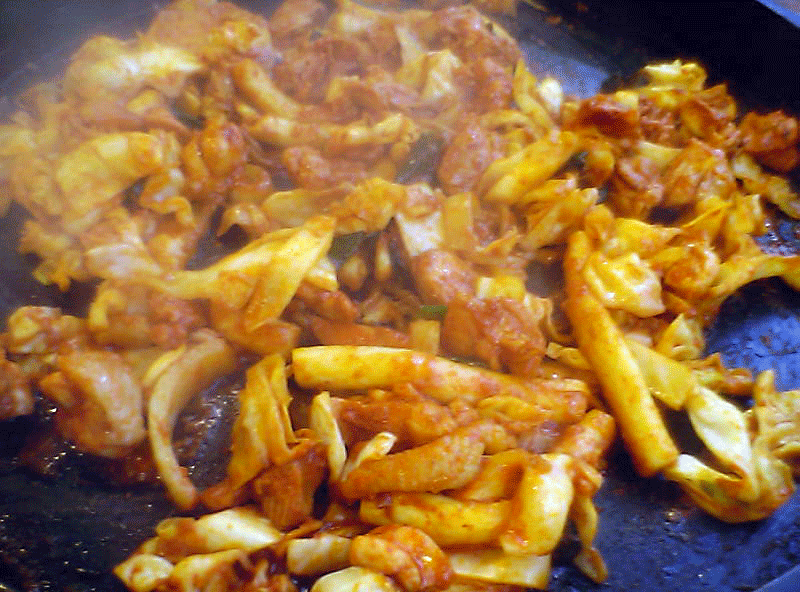
Dakgalbi ('chicken ribs') is a pan-fried mix of boneless chicken, rice cake (ddeok), cabbage, red pepper paste, and other vegetables.
A personal favorite, dakgalbi is not really an option for home cooking and is best enjoyed with a cold beer in a hot restaurant.

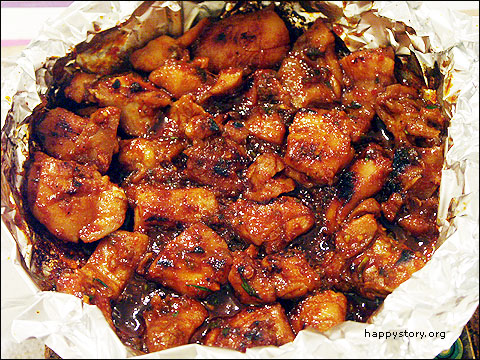
Then there's buldak ('fire chicken')
As I have said many times before, Koreans tend to turn a lot of things that others regard as enjoyable into opportunities for group bonding through shared suffering. That includes Korean comedy as well as Korean food. Buldak is boneless chicken repeatedly basted with red pepper paste and grilled over an open fire. The successive layers of hot sauce render the chicken all but impossible to eat. Buldak exploded as a fad in 2005, starting in the downtown hotspots of Seoul. it quickly spread to the four corners of the country, and now those restaurants are mostly either closed or in the middle of a long painful decline. As a fad, buldak was similar to jjimdak, in that it took everyone by storm and couldn't keep up the momentum to become a fixture. I personally hate buldak, because it divorces food from everything enjoyable about eating, and gives you the spiciest trip to the John you've ever had the next day. Don't eat it.

Last but not least is dakdoritang. The reason I call dakdoritang Korea's answer to freedom fries is because of a dispute involving the name of the food. As you may have figured out by now, dak means ;chicken'. Tang means 'soup' or 'stew'. The offending morpheme is dori, which is actually the Japanese word tori, which means 'chicken'. So it literally means 'chicken chicken soup'. There are a lot of nationalists in Korea, and they don't like Japan, or the Japanese colonial period, or something about Japanese culture, depending on whom you talk to. These people, including the people who make television, don't like to see a Japanese word sticking its tongue out at them from the middle of their menu, so they rather thought-politically change the name from dakdoritang to dakbokkumtang (bokkum, pronounced as in "Poke'em? I hardly even know'em!") means 'pan-fried' or 'braised', so that would make dakbokkumtang 'braised chicken stew', which would be fine, except that not everyone braises the chicken, as you'll soon see. This linguistic revisionism even goes so far as to change every utterance of the word dakdoritang to dakbokkumtang in the closed captioning, even though the only people who say dakbokkumtang are young liberal nationalists.

And now, without further ado, here is my mother-in-law's recipe for dakdoritang, with my advice for how to make it outside Korea.

Ingredients:
2 chickens
soy sauce
a lot of garlic
fresh ginger
carrots
potatoes
onions
sugar
black pepper
gochujang (red pepper paste)


1. Get two chickens at the market. Tell the chicken man that you're making dakdoritang and he'll cut it up approriately. Outside Korea I recommend buying chicken thighs, bone in and skin on, because that's where the flavor is.

2. Put the chicken in a pot full of water and bring it almost to a boil. Some schmaltz will appear on the top of the water.

3. Discard the water.

4. Your chicken should now look like this.

5. Add some soy sauce.

6. More soy sauce.

7. Add even more soy sauce. I reckon she poured in about 1/2 of a cup of soy sauce. At this point it's the only liquid in the pot so the chicken soaks it up.

8. Add red pepper powder. You'll notice that in the picture my mother-in-law is in fact adding red pepper paste. That is because she was not happy with the quality of the two kinds of red pepper paste currently in the house. I suggest that if you are making this outside Korea this wil cut down on expenses, in that you too can use red pepper paste twice instead of buying paste and powder. A heaping wooden spoonful will do. Incidentally, my mother-in-law has thrown her weight behind Haechandle brand gochujang (red pepper paste).

9. Add water. My mother-in-law said she added extra water because I like the sauce, but you can leave it up to taste, adding between 1/2 cup and a cup.

10. Add potatoes, cut roughly as for stew.

11. Add black pepper to taste.

11. Add sugar. I would guess about four tablespoons.

12. This much.

13. Stir and taste.

14. This is where you would normally add the red pepper paste. Again, Haechandle, and about a heaping wooden spoonful.

15. Chop and smash about 8 cloves of garlic.

16. Chop and smash one chunk of fresh peeled ginger. Ginger is the Korean's go-to odor eliminator, and I don't know if dakdoritang usually contains it, but, in an interesting side note, my mother-in-law hates chicken. She never ever eats it, since she was a child and she witnessed a particularly gruesome chicken beheading.

17. Add the garlic and ginger. By now the stew should look like this.

18. Add onions, cut large like the potatoes.

19. Add green onions, again cut roughly into one inch pieces.

20. I reminded my mother-in-law at the last minute that I like carrots, so she added half a carrot to appease me.

20. Cover and let it cook for about 10 minutes and it's good to go.

21. My mother-in-law is a natural showman and insisted that I take this more beautiful and well presented photo of the finished product. I am sure you'll agree she was right.

22. Serve with rice, kimchi, cucumbers, ssamjang, or whatever you want. Serves four.

Friday, April 27, 2007

Cool Things Korean (part 4)

Icheon Ssalbap (이천 쌀밥)
This restaurant takes its name from the town of Icheon, once the farming region from which the Kings of the Joseon Dynasty's rice came. The hypse would seem to suggest some kind of superior quality to the land in Icheon, some salient geomantic advantage for the region or perhaps an ancient pact between the king and the local leaders, but most people believe that the Kings sourced their rice from Icheon because it wasn't too far from Seoul. Ssalbap means rice: Korea has two distinct words for uncooked rice (ssal, pronounced sort of like the name Sol) and cooked rice (bap, pronounced like bop). So ssalbap translates to "ricerice". Anyway, the restaurant's official name is The King's Icheon Ssalbap (임금님의 이천 쌀밥), but folks round these parts usually drop the King.
Truth be told, nobody goes to this restaurant for the rice. After all, not being far from Seoul is no longer a marketing advantage for rice growers, and I suspect a large portion of the CO2 that the rice paddies in question consume comes out of tailpipes. The rice is cooked in a stone pot, and then scooped into a bowl. Hot water is added to the stone pot, where the rice that's scorched onto the red hot bowl soaks in the water and creates a palate cleansing chunky tea called nurungji (누룽지, sometimes translated as 'scorched rice') to be enjoyed at the end of the meal. The real draw here is the side dishes. For 8,000 won apiece (about $8), my wife, mother-in-law and I enjoyed 24 side dishes, a large broiled fish, crab soup , poached egg and kimchi jjigae (all three not pictured) and lettuce and cabbage leaves for wrapping.

The side dishes were:
pulled pork and boiled egg
japchae
spinach
fiddleheads
lettuce with Thousand Islands dressing
pork
beef
sweet and sour pork
bean sprouts
shiitake mushrooms
kimchi
garlic stalks
dotori (acorn) muk
doraji (Chinese bellflower root)
potato salad
steamed octopus and broccoli with vinegared red pepper paste fer dippin' (tastes alot better than it sounds)

Sure, some of the side dishes are straight junk (Thousand Islands?) but for the experience alone this place is well worth the eight grand. Plus you get all the plum juice and shikhye (kind of a sweetened rice juice, with rice still floating in it) you can drink.

Saturday, April 14, 2007

Cool things Korean (part 3)

Sutamyun
The other day Miyoung and I were on our way home from work and looking for a place to eat. She suggested the food court in the basement of the GS Square department store, and who am I to say no? Actually I know that mall and department store food courts in Korea are some of the best places to eat around. Rather than being made uniform by the presence of chains like the U.S., the Korean food court consists of nameless kitchens, each with its own specialty. In fact, some of my favorite places to get certain foods are in food courts. We had never been to this food court before, so we ordered an old standby, jajangmyun (or jjajangmyun, 자장면). Jajangmyun is basically noodles (myun) and jajang sauce, which is a heady black mixture of fermented black bean paste, onions, a little potato and carrot and whatever else granny's recipe calls for. Very savory, very delicious, jajangmyun is beloved by children, who can often be seen with black smears at the corner of their mouth. I neglected to take a picture of the food in my zeal to eat it, so here's a stock photo.
Interesting side note about the word 'myun'. This is the Korean pronunciation of the Chinese word for noodles (originally meaning 'flour') that spread throughout Asia and even into America. Perhaps you've had chow mein? Same word: in Mandarin chao mian means fried noodles. How about ramen? Men is the Japanese pronunciation of this word. They all share the same Chinese character.
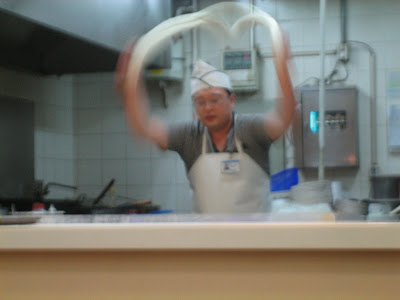
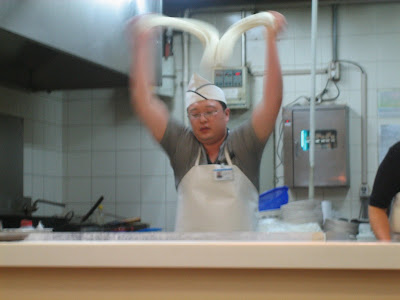
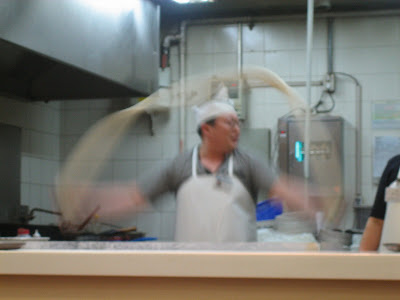
What we didn't realize when we ordered was that this kitchen was serving suta jajangmyun. Suta literally means 'hand beaten'. We had a seat next to the kitchen, and we saw the cook readying a big wad of dough and knew what was coming, but the lady next to us didn't see. The cook pulled the dough apart and loudly thwacked it down on the floured counter. The woman must have jumped a foot.
The whole point of all the thwacking is to pull the wad of dough to double its length, so you can fold it over and thwack it again. Do this ten or fifteen times and instead of holding a wad of dough, you've got two or three servings of noodles in your hand. Watching an expert tease these noodles out to their full length is amazing.


Incidentally, this was served with the best jajang sauce I've ever had. So if you ever happen to be in the GS Square Department Store in Bucheon, go down into the basement and order a bowl of jajangmyun.

Monday, April 09, 2007

Levy's Real Jewish Rye

Have you ever had Levy's Real Jewish Rye? What a great bread.
Levy's was always my family's favorite sandwich bread growing up. It goes great with any cold cut, it's the perfect venue for mustard, it even toasts well. The wrapping is attractively melted around the bread, giving an unparalleled effect that twisty-tied white breads lack, as well as making consuming the bread before it goes stale a race against time. Better to go to the deli, get some pickles, mayo, Gulden's Spicy Brown mustard, ham, turkey, liverwurst, cracked pepper turkey, big juicy tomatoes and lettuce and invite all your friends to help polish off the whole loaf. In my own lazy search I couldn't find any availability info, so I wonder if this classic product is only available in New York. I know it's not available in Korea. Here they have the palest of pale imitations of rye bread imaginable, essentially Wonder Bread with a dash of rye thrown in, giving nothing if not a tantalizing hint of all that I left behind in America. Incidentally, eating Levy's Real Jewish Rye was on my short list of things to do when I went back to the States two years ago, but it got bumped off the list by silly things like seeing friends and family, so I haven't eaten this venerable product for over four years. But If I close my eyes I can still taste it.
Check out these photos I found of a 70s-era Levy's ad campaign. Awesome.


This lucky guy bears an uncanny resemblance to The Host star Byeon Hee-bong. As a matter of fact, go watch the trailer for The Host right now, and rent it tonight, it's great.


Tuesday, April 03, 2007

Cool things Korean (part 1)

There are times when those living in Korea are faced with the question "What am I doing here?" One of the best examples of such a time is during the early spring "yellow dust" season during which Korea is blanketed with, um, yellow dust from China's recently deforested desert region. Thanks China!

I was taking a picture of the tree but check out that yellow dust. This was ten o'clock Sunday morning.
And so when faced with media hysteria about yellow dust, I am left seeking justifications for my continued presence in a country in eminent danger of being completely plowed under by fine particulate matter. Here's what I came up with.

1. Corn Ice Cream
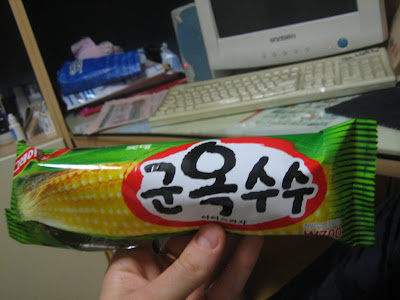
I'm talking about the Gunoksusu corn ice cream bar. a thick tube of corn ice cream with real corn niblets churned right in, wrapped in a thin layer of chocolate and ensconced in a soft corn-shaped wafer, giving it a strong resemblance to an actual ear of corn. Here's the wrapper

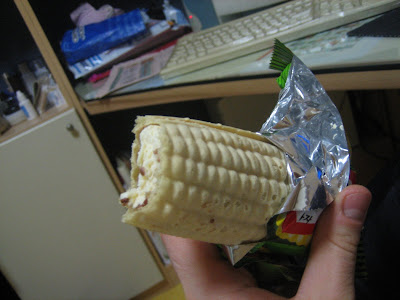
And here's a cross-section.

Unfortunately I was not able to coax a niblet to the surface to be photographed, but imagine a soft, chewy piece of corn in chilly corny ice cream. Makes all that severe respiratory risk worthwhile.

2. T Money
Actually the whole concept of proximity cards. So you want to ride the bus or subway? Get yourself a transit card, either a credit card with transit card capabilities or a debit transit card, and you never have to take it out of your wallet or purse. When you go through the turnstyle or get in the bus, just slap your whole wallet or bag onto the T Money thingy and it will deduct the appropriate amount from your account or charge you. Better still, when you get off the bus to transfer, slap that puppy on there again and it'll automatically discount your transfer.
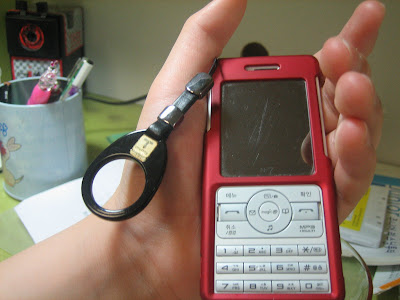
But the single coolest thing about the whole proximity technology is that it's not limited to cards.

That's my student Ucheol's phone, and the little black cell phone bauble to the left is his T Money card. See the little gold T on there? It's smaller than a ring pop for crying out loud!