I had my last wisdom tooth out yesterday. Injections (very deep) in four spots, a five minute wait and then an attempt. I halted the procedure due to unendurable pain and the dentist gave me shots in two more spots. Another five minutes and he had me in a headlock again with a glorified pair of pliers clamped onto my upper right wisdom tooth, or love tooth (사랑니) as the Koreans call them. He pulled and it hurt nearly as much as it did the first time, but I had a sense that another injection woulld do no good, as I was numb from my nostrils to my throat except the area around my wisdom tooth. I knew from the other ones that my upper teeth were straight shots, easy to pull out, unlike my lowers, which had hooked roots and had to be decapitated and then have each root individually pulled out. I just closed my eyes and waited for the pain to pass. It was excruciating, but it did pass, amazingly fast, and the dentist was sticking a huge piece of gauze in my mouth before I knew it. He beckoned me over to look. "This is infection. This is why the anaesthesia didn't work" he would have said if he didn't speak such awful English. Drink milk in a half hour, take the gauze out in an hour, and here's a two-day prescription for pain killers, only take them if you experience pain. Boom, I was done inside of twenty minutes.
I imagined upon leaving that this must be what it's like to give birth to your fourth baby.
Wednesday, August 15, 2007

Saturday, August 11, 2007
I may never be hungry again
I wake up in the morning and, far from wanting breakfast, I steel my already full stomach for another day of eating too much. Why, you ask?
Why, because I have to go out to eat with everybody I've ever met in Korea. And since they're not going anywhere, they want to go somewhere special. I literally haven't eaten anything normal in a week. Here's a partial list of the foods I've eaten and the places I've eaten them in.
By the way, my plans for today? Lunch with friends followed by dinner and drinks with other friends. Wincing? Consider it a certainty.
Why, because I have to go out to eat with everybody I've ever met in Korea. And since they're not going anywhere, they want to go somewhere special. I literally haven't eaten anything normal in a week. Here's a partial list of the foods I've eaten and the places I've eaten them in.
- Grilled duck, acorn muk (jelly), and a giant octopus pancake next to a waterfall
- spicy grilled octopus (낙지 볶음) with another giant octopus pancake
- All you can eat tuna sashimi and a ton of beer with my brother in law
- Giant katsu (deep fried pork, fish, and chicken cutlets) and cold spicy noodles (냉면)
- Heaps of fancy Chinese food
- Rice cooked in a segment of a bamboo tree with about a million side dishes
- VIPs (buffet)
- Blue Ocean (buffet)
- Dijon Euro (fusion-style buffet) twice
- About a million patbingsu (sweet bean and shaved ice treats)
- About a million free Starbucks coffees
By the way, my plans for today? Lunch with friends followed by dinner and drinks with other friends. Wincing? Consider it a certainty.
Thursday, August 09, 2007
A gallery of human failures
The Smoking Gun has a delightful gallery of mugshots where the people are wearing T-shirts with funny words on them. While many of the people appear to have been ravaged by years of drug and alcohol abuse, many of them are fresh-faced young kids. I don't know where this guy would fall.
 But I like his shirt the most.
This sort of thing fills me with sweet sadness. Thinking about the kinds of things these people likely did to get arrested makes me wish i had enough money to personally send every man, woman and child in America to military school. Stop having fun, dummies!
 But I like his shirt the most.
This sort of thing fills me with sweet sadness. Thinking about the kinds of things these people likely did to get arrested makes me wish i had enough money to personally send every man, woman and child in America to military school. Stop having fun, dummies!
I am leaving Korea in a week
And I can honestly say that I will miss it much more than I ever missed America. Why?
I suppose the reason is that I have America inside me. If I had to I could probably make America over again, but Korea will forever be an outside influence on me, no matter how much I've internalized.
Perfect example, I just wrote 'nomatter' as a single word, apparently my subconscious brain's translation from one Korean word (아무리) to English.
There are so many things to worry about. I lost 180 pounds in Korea. Will returning to America put me back on my diet for death? Will I forget massive amounts of my hard-won Korean? Will I lose touch with the culture? Will I forget all the important lessons about people that I learned here?
And then there are the regrets. There are those who've spent their time in Korea mining its history for wisdom. There are those who've spent it having fun, blissfully unaware of the world going on around them. There are those who've spent their time in Korea viciously poking holes in the hypocrisy, the illogic, the foolishness that one finds here. I have spent my small time here trying to really understand the world as modern Koreans see it. I effectively walled myself off from the non-Korean world. In 2006 I spoke face-to-face with non-Koreans less than 10 times. The Japanese colonial period, the Yangbans and the early Christian missionaries are as far from me as they are to the average Korean man on the street, but it is a rare trend or buzzword that I have not heard about.
I believe in secular humanism, a world without a god in which people have been created in the forge of evolution for no particular purpose and culture is a mere element of our extended phenotype. To the extent that I believe the past effects the present, I don't think things systematically forgotten or dumbed down to a nub have any bearing on the present and thus I am not a huge fan of history as a window on the present. When I view the Koreans of today I see them as products of their environment, and that environment a product of history, a crucial distinction. When I came here I wanted to feel what Koreans feel and know what Koreans know, unhampered by half-baked connections to the past. Korea is often a country of pure emotion,and to approach it on any other level seemed and still seems foolish to me. To try to use facts in a way in which they are not used in Korea seems silly and almost (gulp) imperialistic. Now is a time for me to look back and think seriously about whether I have made the right decision, whether I have seen what I wanted to see and taken away what I wanted to take away.
I have managed in my time here to stretch my mind more than I ever thought possible. I have come to understand mindsets that I once ridiculed and among those I have even found those that I accept. Through it all I have not lost my own perspective, not become like putty that can take any form and has none to call its own. I have been able to call a spade a spade and to see when I was wrong.
Coming to Korea was the best thing that ever happened to me. Anyone that knew me will tell you so, and yet when I came here I had no idea that it would wind up this way. How much of this is Korea and how much of this is the natural process of an arrested adolescent becoming a man? This is impossible to answer and perhaps doesn't deserve one. Had I gone to China would I now be extolling the great reformative effect of Chinese culture on me? Impossible to say.
What I can say with some certainty is that I have learned far more in Korea than I ever set out to or even knew to set out to. I learned to suffer fools, and as much as that would enrage the high school, OK Computer-listening boy I once was, that is a valuable skill. I learned both the power of being on the outside and exempt from society's rules and the power that comes from being an insider and being bound to those rules. I learned how to function in a society I never thought I would have more than a fleeting relationship and I learned respect for people whose lives are as different from those I grew up around as possible.
So did I make the right choice? Should I have been visiting historical sites, dabbling in some University arts scene or hunting girls in Itaewon? Would I have better spent my time snowboarding, studying Joseon-period documents or lecturing every Korean that I met about what's wrong with their country? Or might I have been better off just cocooning myself off from the country altogether, meeting my foreigner friends every night of the week and otherwise behaving like a jolly colonial git?
I honestly don't know, although I have a strong suspicion that I have made the right decision. Every kind of expat in Korea that I have described is a real person and I would love to hear what they think, but with this blog's readership I don't see that happening.
Korea is a complicated place. It is so easy to peg it as any one thing that it is not, and to paint roll it with any label that you want. It's like Ireland. It's like Italy. It's like Cold War-era Germany, it's an agrarian blah blah but the people all blahed, It's the best example of American nation building, it's whatever your heart desires.
But it's not any of those things. I won't even attempt to say what it is. That's a fool's errand, and since coming to Korea one of the things I've learned is not to answer every question that's put to me.
I suppose the reason is that I have America inside me. If I had to I could probably make America over again, but Korea will forever be an outside influence on me, no matter how much I've internalized.
Perfect example, I just wrote 'nomatter' as a single word, apparently my subconscious brain's translation from one Korean word (아무리) to English.
There are so many things to worry about. I lost 180 pounds in Korea. Will returning to America put me back on my diet for death? Will I forget massive amounts of my hard-won Korean? Will I lose touch with the culture? Will I forget all the important lessons about people that I learned here?
And then there are the regrets. There are those who've spent their time in Korea mining its history for wisdom. There are those who've spent it having fun, blissfully unaware of the world going on around them. There are those who've spent their time in Korea viciously poking holes in the hypocrisy, the illogic, the foolishness that one finds here. I have spent my small time here trying to really understand the world as modern Koreans see it. I effectively walled myself off from the non-Korean world. In 2006 I spoke face-to-face with non-Koreans less than 10 times. The Japanese colonial period, the Yangbans and the early Christian missionaries are as far from me as they are to the average Korean man on the street, but it is a rare trend or buzzword that I have not heard about.
I believe in secular humanism, a world without a god in which people have been created in the forge of evolution for no particular purpose and culture is a mere element of our extended phenotype. To the extent that I believe the past effects the present, I don't think things systematically forgotten or dumbed down to a nub have any bearing on the present and thus I am not a huge fan of history as a window on the present. When I view the Koreans of today I see them as products of their environment, and that environment a product of history, a crucial distinction. When I came here I wanted to feel what Koreans feel and know what Koreans know, unhampered by half-baked connections to the past. Korea is often a country of pure emotion,and to approach it on any other level seemed and still seems foolish to me. To try to use facts in a way in which they are not used in Korea seems silly and almost (gulp) imperialistic. Now is a time for me to look back and think seriously about whether I have made the right decision, whether I have seen what I wanted to see and taken away what I wanted to take away.
I have managed in my time here to stretch my mind more than I ever thought possible. I have come to understand mindsets that I once ridiculed and among those I have even found those that I accept. Through it all I have not lost my own perspective, not become like putty that can take any form and has none to call its own. I have been able to call a spade a spade and to see when I was wrong.
Coming to Korea was the best thing that ever happened to me. Anyone that knew me will tell you so, and yet when I came here I had no idea that it would wind up this way. How much of this is Korea and how much of this is the natural process of an arrested adolescent becoming a man? This is impossible to answer and perhaps doesn't deserve one. Had I gone to China would I now be extolling the great reformative effect of Chinese culture on me? Impossible to say.
What I can say with some certainty is that I have learned far more in Korea than I ever set out to or even knew to set out to. I learned to suffer fools, and as much as that would enrage the high school, OK Computer-listening boy I once was, that is a valuable skill. I learned both the power of being on the outside and exempt from society's rules and the power that comes from being an insider and being bound to those rules. I learned how to function in a society I never thought I would have more than a fleeting relationship and I learned respect for people whose lives are as different from those I grew up around as possible.
So did I make the right choice? Should I have been visiting historical sites, dabbling in some University arts scene or hunting girls in Itaewon? Would I have better spent my time snowboarding, studying Joseon-period documents or lecturing every Korean that I met about what's wrong with their country? Or might I have been better off just cocooning myself off from the country altogether, meeting my foreigner friends every night of the week and otherwise behaving like a jolly colonial git?
I honestly don't know, although I have a strong suspicion that I have made the right decision. Every kind of expat in Korea that I have described is a real person and I would love to hear what they think, but with this blog's readership I don't see that happening.
Korea is a complicated place. It is so easy to peg it as any one thing that it is not, and to paint roll it with any label that you want. It's like Ireland. It's like Italy. It's like Cold War-era Germany, it's an agrarian blah blah but the people all blahed, It's the best example of American nation building, it's whatever your heart desires.
But it's not any of those things. I won't even attempt to say what it is. That's a fool's errand, and since coming to Korea one of the things I've learned is not to answer every question that's put to me.
Tuesday, August 07, 2007
The exquisite pain of Korean victimhood
Here is a short list of ways in which Korea's obsession with victimhood manifests itself
- In daytime dramas which center around a woman with a dopey victim-y hairstyle being cruelly mistreated and suffering through it passively (문희, 금순이).
- In historical films in which the main characters are helpless victims of historical circumstances passively tossed about by the viscissitudes of the time.
- In hysterical news reports about foreign English teachers come to Korea to have sex with Korean women.
- In hysterical news reports about foreign investors carting off steamer trunks full of money while leaving nothing behind for the Koreans.
- In Korean American antisemitism.
- In hysterical news reports about foreign companies (Mercedes, Starbucks) selling their products at high prices in Korea.
Feel free to add your own.
Monday, August 06, 2007
Jeolla Province Trip day 1 of 4 (Bogil Island)
Miyoung and I just got back from our four day trip to Jeolla Province. It was a fantastic time, and there are a lot of beutiful things down there that I definitely recommend you see if you get a chance.
A lot of people bag on package tours. I consider this a form of time snobbery. Having enough time to just go and traipse around on your own and 'discover' things is always talked up like some kind of trailblazing heroic thing to do. The fact is that in most places, if you go there to wander around and discover new surprises around every corner you're going to spend a lot of time doing things that aren't that great. Miyoung and I only had two weeks left in Korea, so we didn't have the luxury of time, so Miyoung put together three local tours into one super-tour, and I have to say that it was great.
Thursday
Left home at 7:00, took a taxi to Bucheon station and caught the rapid train to Yongsan station. The DMB television that Miyoung's sister lent us for the trip was cool, but it repeatedly lost the signal on the subway ride. When we arrived at Yongsan we couldn't turn it off and had to reset it, at which point it mercifully died and we were free of it for the rest of the trip.
Took the 8:30 KTX to Mokpo station (목포역). KTX is Korea's version of the high speed train. It was my first time going to Mokpo but it still seemed to me that 3 and a half hours was on the long side for the trip. At Mokpo station we met up with our bus and went to a big old neighborhood restaurant near the station and had a kimchi jjigae (김치찌개). This was my first taste of Jeolla-do's famous food, which was in this case not that great; the kimchi was extremely salty and everything else was as it would be back at home.
Full of salt, we were ready to move on to Bogil Island (보길도 or Bogildo). That meant going to Land's End (땅끝), the place where South Jeolla Province goes from continuous landmass to archipelago. We had a smooth hour ride until we got to the area around Land's End Town (땅끝마을) which was fairly swarming with tourists. Dirty tourists. For all the talk of love for their country, Koreans by and large have little concept of their actual impact on it. To quote my mother-in-law as she watched a news report about dirty tourists "Koreans are dirty." There, see, I didn't say it, I quoted a Korean who said it. Anyway, the entire landscape of Land's End is encrusted with ice cream wrappers, beer bottles, overturned barbecues, etc. My wife would not have me taking pictures of people's garbage, but I think you get the drift just from my description.
After a 40 minute traffic snarl on the mountain road around Land's End (the retaining wall next to the road is covered with 'Jinuk wuz here'-style graffiti, leading me to believe that such traffic jams are not uncommon) we got to the ferry to Bogil Island. The weather was hot but magically not that hot, and I managed to stay miraculously sweat free even as we waited for the ferry about 20 minutes on te shade-free pier.

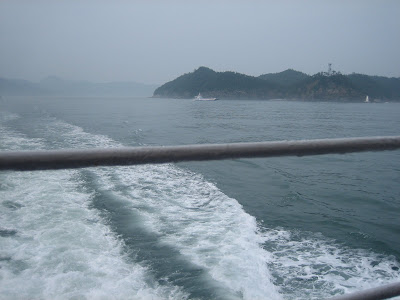
This is the view from the back of the ferry of one of the many islands making up Dadohe (다도해 or 多島海, The Sea of Many Islands, to put it somewhat inartfully). The weather remained similarly foggy throughout the entire trip
On our approach to the island I was shocked to see mile after mile of sea farms raising abalone and various forms of seaweed.
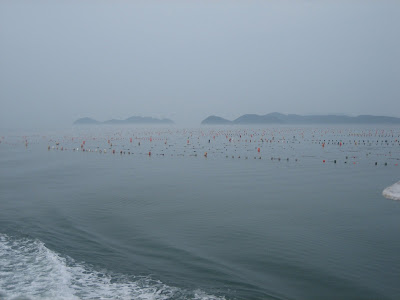
Just to give you some perspective, the ferry was flying along at a pretty fast clip, and I took the above and below photos about 10 minutes apart. In other words, the waters around the island are cultivated as far as the eye can see.

This bridge, which is not completed, connects the Bogil Island of leatherneck fisherman with the Bogil Island of pretty beaches, scenic spots, raw fish restaurants, and lily white Seoulites with pink T-shirts and old rural-to-urban transplants trying to reconnect with their roots.

The aforementioned Bogil town, where the restaurants serve kimbab, Chinese food, and spaghetti.
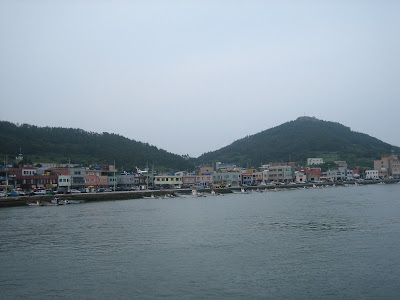
Tourist Bogildo, where the restaurants exclusively serve the frutti of the mare. Except this one Chinese restaurant that Miyoung went to once when she was a poor backpacker and had jajangmyun.

Upon arrival, unloading of our bus, reboarding of said bus we proceeded ten minutes along the shore to Jungri beach. There are other beaches on Bogil Island but this one, our guide says, is the best, and why would he lie?

The consistency of the beach was fantastic. The sand was so fine that the waves picked it up and got clouded with it, but the beach was also covered with seashells of all kinds, smashed to smithereens, presumably by the duel forces of nature and time or perhaps by seagulls. However while scrounging around the beach I found something I had never seen on a beach before: a shell that had somehow managed to not be completely picked clean by scavengers, still containing traces of its former occupants. This place is so laid back even the seagulls half-ass it.

We spent the night in a nice little guest house (민박). I was struck by the children of the owners who were lounging around enjoying their summer vacation. they had all the cards, comic books and other junk that my kids back in Bucheon had, plus super soakers, which they didn't have back in Bucheon, plus the beach and the mountains, plus they didn't seem to go to hagwons all summer, plus they didn't seem to be burdened by countrified accents that would someday serve to hold them back. And this was where they were spending their summer vacation.
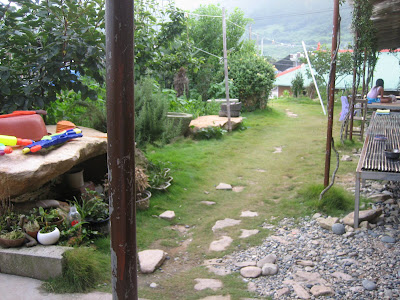
The rooms, by the way, were made of red earth (황토). This is believed by many (not me) to be good for you, and I heard more than once the bullshit detector needle burying, correlation and causation confounding statement "Long ago we lived in houses of red earth and we had no atopy (a kind of eczema), so buy this bottle of dirt/shirt dyed in dirt/makeup made of dirt/dirt cake/etc."
Anyway, after getting settled we went out to take some pictures at some scenic spots. The first one was some kind of promontory from which you could actually see Jeju Island on clear day. Of course this was a very very foggy day, so I just took pictures of my wife.
Wife and island

Wife and cliff face

Then we went to Dinosaur Egg Beach, which, despite being burdened with a stupid name, is one of the most interesting places we visited. Essentially a horseshoe-shaped beach with a round island in the middle, the shoreline is made up of large dinosaur egg-shaped rocks that make a satisfying sound when trod upon.

To the right of the beach is a beautiful bald hill.
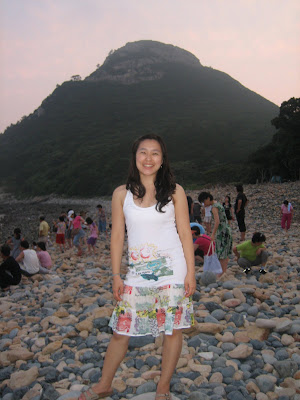
After taking pictures and having our feet scurried over by giant rock-dwelling bugs, it was time to go down to tourist town for a raw fish dinner. When the bus stopped, the tour guide said in a very off-hand way 'This is a good restaurant' while waving his hand in the general direction of the restaurant that the bus stopped directly in front of. I was shocked to see almost everyone on the bus dutifully file into the restaurant, and, ever the trailblazing package tourist, I insisted to Miyoung that we go to another restaurant. The result: just okay. The restaurant we wound up going to seemed very expensive, and the side dishes were nothing special. The fish, as was to be expected, was excellent, and included fresh raw wriggling octopus, sea cucumber and sea anemone (not wriggling, of course).
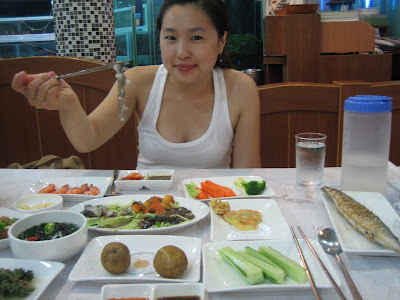
Oh, and potatoes. Jeolla Province seems pretty big on small potatoes.
Next Time: Adventure (and napping) on the high seas, grand temples, man-eating fish and more!
A lot of people bag on package tours. I consider this a form of time snobbery. Having enough time to just go and traipse around on your own and 'discover' things is always talked up like some kind of trailblazing heroic thing to do. The fact is that in most places, if you go there to wander around and discover new surprises around every corner you're going to spend a lot of time doing things that aren't that great. Miyoung and I only had two weeks left in Korea, so we didn't have the luxury of time, so Miyoung put together three local tours into one super-tour, and I have to say that it was great.
Thursday
Left home at 7:00, took a taxi to Bucheon station and caught the rapid train to Yongsan station. The DMB television that Miyoung's sister lent us for the trip was cool, but it repeatedly lost the signal on the subway ride. When we arrived at Yongsan we couldn't turn it off and had to reset it, at which point it mercifully died and we were free of it for the rest of the trip.
Took the 8:30 KTX to Mokpo station (목포역). KTX is Korea's version of the high speed train. It was my first time going to Mokpo but it still seemed to me that 3 and a half hours was on the long side for the trip. At Mokpo station we met up with our bus and went to a big old neighborhood restaurant near the station and had a kimchi jjigae (김치찌개). This was my first taste of Jeolla-do's famous food, which was in this case not that great; the kimchi was extremely salty and everything else was as it would be back at home.
Full of salt, we were ready to move on to Bogil Island (보길도 or Bogildo). That meant going to Land's End (땅끝), the place where South Jeolla Province goes from continuous landmass to archipelago. We had a smooth hour ride until we got to the area around Land's End Town (땅끝마을) which was fairly swarming with tourists. Dirty tourists. For all the talk of love for their country, Koreans by and large have little concept of their actual impact on it. To quote my mother-in-law as she watched a news report about dirty tourists "Koreans are dirty." There, see, I didn't say it, I quoted a Korean who said it. Anyway, the entire landscape of Land's End is encrusted with ice cream wrappers, beer bottles, overturned barbecues, etc. My wife would not have me taking pictures of people's garbage, but I think you get the drift just from my description.
After a 40 minute traffic snarl on the mountain road around Land's End (the retaining wall next to the road is covered with 'Jinuk wuz here'-style graffiti, leading me to believe that such traffic jams are not uncommon) we got to the ferry to Bogil Island. The weather was hot but magically not that hot, and I managed to stay miraculously sweat free even as we waited for the ferry about 20 minutes on te shade-free pier.

This is the view from the back of the ferry of one of the many islands making up Dadohe (다도해 or 多島海, The Sea of Many Islands, to put it somewhat inartfully). The weather remained similarly foggy throughout the entire trip
On our approach to the island I was shocked to see mile after mile of sea farms raising abalone and various forms of seaweed.
Just to give you some perspective, the ferry was flying along at a pretty fast clip, and I took the above and below photos about 10 minutes apart. In other words, the waters around the island are cultivated as far as the eye can see.

This bridge, which is not completed, connects the Bogil Island of leatherneck fisherman with the Bogil Island of pretty beaches, scenic spots, raw fish restaurants, and lily white Seoulites with pink T-shirts and old rural-to-urban transplants trying to reconnect with their roots.

The aforementioned Bogil town, where the restaurants serve kimbab, Chinese food, and spaghetti.
Tourist Bogildo, where the restaurants exclusively serve the frutti of the mare. Except this one Chinese restaurant that Miyoung went to once when she was a poor backpacker and had jajangmyun.

Upon arrival, unloading of our bus, reboarding of said bus we proceeded ten minutes along the shore to Jungri beach. There are other beaches on Bogil Island but this one, our guide says, is the best, and why would he lie?

The consistency of the beach was fantastic. The sand was so fine that the waves picked it up and got clouded with it, but the beach was also covered with seashells of all kinds, smashed to smithereens, presumably by the duel forces of nature and time or perhaps by seagulls. However while scrounging around the beach I found something I had never seen on a beach before: a shell that had somehow managed to not be completely picked clean by scavengers, still containing traces of its former occupants. This place is so laid back even the seagulls half-ass it.

We spent the night in a nice little guest house (민박). I was struck by the children of the owners who were lounging around enjoying their summer vacation. they had all the cards, comic books and other junk that my kids back in Bucheon had, plus super soakers, which they didn't have back in Bucheon, plus the beach and the mountains, plus they didn't seem to go to hagwons all summer, plus they didn't seem to be burdened by countrified accents that would someday serve to hold them back. And this was where they were spending their summer vacation.
The rooms, by the way, were made of red earth (황토). This is believed by many (not me) to be good for you, and I heard more than once the bullshit detector needle burying, correlation and causation confounding statement "Long ago we lived in houses of red earth and we had no atopy (a kind of eczema), so buy this bottle of dirt/shirt dyed in dirt/makeup made of dirt/dirt cake/etc."
Anyway, after getting settled we went out to take some pictures at some scenic spots. The first one was some kind of promontory from which you could actually see Jeju Island on clear day. Of course this was a very very foggy day, so I just took pictures of my wife.
Wife and island

Wife and cliff face

Then we went to Dinosaur Egg Beach, which, despite being burdened with a stupid name, is one of the most interesting places we visited. Essentially a horseshoe-shaped beach with a round island in the middle, the shoreline is made up of large dinosaur egg-shaped rocks that make a satisfying sound when trod upon.

To the right of the beach is a beautiful bald hill.
After taking pictures and having our feet scurried over by giant rock-dwelling bugs, it was time to go down to tourist town for a raw fish dinner. When the bus stopped, the tour guide said in a very off-hand way 'This is a good restaurant' while waving his hand in the general direction of the restaurant that the bus stopped directly in front of. I was shocked to see almost everyone on the bus dutifully file into the restaurant, and, ever the trailblazing package tourist, I insisted to Miyoung that we go to another restaurant. The result: just okay. The restaurant we wound up going to seemed very expensive, and the side dishes were nothing special. The fish, as was to be expected, was excellent, and included fresh raw wriggling octopus, sea cucumber and sea anemone (not wriggling, of course).
Oh, and potatoes. Jeolla Province seems pretty big on small potatoes.
Next Time: Adventure (and napping) on the high seas, grand temples, man-eating fish and more!
Wednesday, August 01, 2007
Well aware of how but not why
In an article from Korea's Yonhap news agency about the steps being taken by the Korean government in response to the Taliban taking 23 Korean hostages and killing two of them, Presidential spokesman Cheon Ho-seon says
I realize Korea is not the world's strongest nation, but I have to question whether this insistence on rescuing the hostages has anything to do with the fact that the President, Roh Mu-hyun, is a Christian, just like the missionary aid workers currently being held in Afghanistan.
It seems to me that the only people here legitimately behind the hostages are other Christians. While I am most certainly oversimplifying this issue, I prefer to think that I am speeding up the process of rounding all the edges off history.
But seriously, military intervention completely ruled out? Using flexibility, that's just another way to say appeasement, right?
He then goes on to state that the kidnappers' demands are well outside of Korea's abilities and that the government opposes any military actions until the last minute.The government is well aware of how the international community deals with these kinds of abduction cases. But it also believes that it would be worthwhile to use flexibility in the cause of saving the precious lives of those still in captivity and is appealing the international community to do so.
I realize Korea is not the world's strongest nation, but I have to question whether this insistence on rescuing the hostages has anything to do with the fact that the President, Roh Mu-hyun, is a Christian, just like the missionary aid workers currently being held in Afghanistan.
It seems to me that the only people here legitimately behind the hostages are other Christians. While I am most certainly oversimplifying this issue, I prefer to think that I am speeding up the process of rounding all the edges off history.
But seriously, military intervention completely ruled out? Using flexibility, that's just another way to say appeasement, right?
Subscribe to:
Posts (Atom)

