So I've been playing with Windows Movie Maker because I am working on my video resume (coming soon!) and I just so happened to shoot some really neat video today. It provided the perfect excuse to practice some simple editing and give you a peek at some great Bucheonnage.
Here is a group of child drummers performing in honor of Buddha's Birthday, which is today. The end also features a great view of a nice carefree ajeosshi dancing and keeping everyone's spirits up in the torrential downpour. Forgive my unsteady hand towards the middle, it ain't easy to do a 360 pan with an umbrella in your hand.
Showing posts with label Cool Things Korean. Show all posts
Showing posts with label Cool Things Korean. Show all posts
Thursday, May 24, 2007

Tuesday, May 15, 2007
Has a good chance of being the best Korean movie of 2007
Jump directly to 45 seconds so you can skip the interminable tacked on theme music.
We (royal we) here at the Paint Roller Blog salute you, Joe McPherson, for all your fine works to promote Korea, including ZenKimchi.
We (royal we) here at the Paint Roller Blog salute you, Joe McPherson, for all your fine works to promote Korea, including ZenKimchi.
Saturday, May 05, 2007
Cool Things Korean (part 5)
You know that feeling you get when you come home from a long, hard day of work and the kitchen table is covered with large, wholesale quantities of traditional Korean snack food? Yeah, that feeling. Well, I'll lay it out for you. You walk in the door and this is the sight you're greeted with.
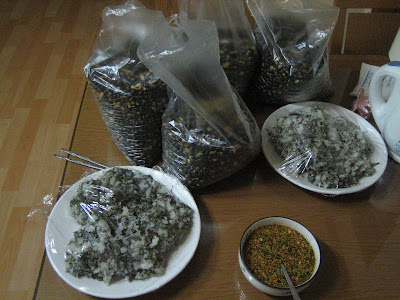
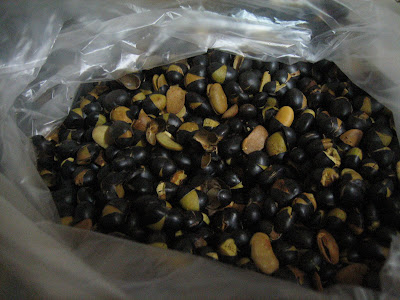
The gigantic bags are full of roasted black beans.
The plates are covered with ssukddeok (쑥떡), which means 'mugwort rice cake' and is basically mugwort, a plant that grows wild and that is considered a weed in North America, mixed in with rice flour and, I conjecture, something sweet.
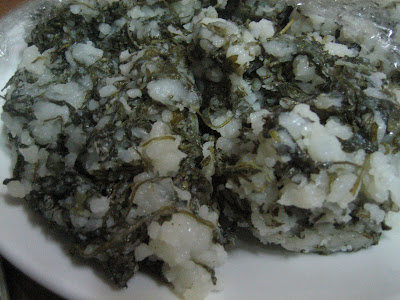
The resulting flavor is something else entirely. It strikes a great balance between sweet, gooey snackiness and herby, mediciney healthiness, and it tastes delicious.
This stuff, well, I don't know. Soy sauce and some stuff, I think.
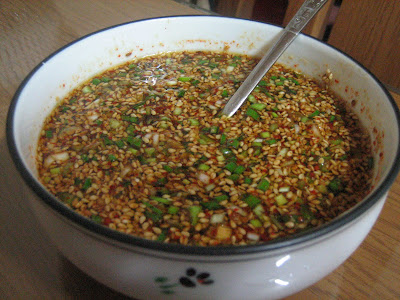
Actually, it's soy sauce, vinegar, sesame seeds, and chives. Does a body good and goes well with pajeon. In fact the above bowl is probably enough of the stuff for 25 large pajeon.
It's nice to come home to all these things. Unfortunately all of these things have their downsides. You really have to eat the ssukddeok fast, so basically stop eating everything for a couple of days and chow down on it until it's gone or what's left has gone bad. And the beans give you unbearable, painful gas. And the soy sauce is really pretty limited use. And when you have a ton of all those things, you really have to eat them until you hate them. When I took these pictures on Monday I was salivating. It's now Saturday and I hate them all and will until I've forgotten what they taste like and they appear on my kitchen table out of the blue. The circle of life continues.
The gigantic bags are full of roasted black beans.
The plates are covered with ssukddeok (쑥떡), which means 'mugwort rice cake' and is basically mugwort, a plant that grows wild and that is considered a weed in North America, mixed in with rice flour and, I conjecture, something sweet.
The resulting flavor is something else entirely. It strikes a great balance between sweet, gooey snackiness and herby, mediciney healthiness, and it tastes delicious.
This stuff, well, I don't know. Soy sauce and some stuff, I think.
Actually, it's soy sauce, vinegar, sesame seeds, and chives. Does a body good and goes well with pajeon. In fact the above bowl is probably enough of the stuff for 25 large pajeon.
It's nice to come home to all these things. Unfortunately all of these things have their downsides. You really have to eat the ssukddeok fast, so basically stop eating everything for a couple of days and chow down on it until it's gone or what's left has gone bad. And the beans give you unbearable, painful gas. And the soy sauce is really pretty limited use. And when you have a ton of all those things, you really have to eat them until you hate them. When I took these pictures on Monday I was salivating. It's now Saturday and I hate them all and will until I've forgotten what they taste like and they appear on my kitchen table out of the blue. The circle of life continues.
Friday, April 27, 2007
Cool Things Korean (part 4)
Icheon Ssalbap (이천 쌀밥)
This restaurant takes its name from the town of Icheon, once the farming region from which the Kings of the Joseon Dynasty's rice came. The hypse would seem to suggest some kind of superior quality to the land in Icheon, some salient geomantic advantage for the region or perhaps an ancient pact between the king and the local leaders, but most people believe that the Kings sourced their rice from Icheon because it wasn't too far from Seoul. Ssalbap means rice: Korea has two distinct words for uncooked rice (ssal, pronounced sort of like the name Sol) and cooked rice (bap, pronounced like bop). So ssalbap translates to "ricerice". Anyway, the restaurant's official name is The King's Icheon Ssalbap (임금님의 이천 쌀밥), but folks round these parts usually drop the King.
Truth be told, nobody goes to this restaurant for the rice. After all, not being far from Seoul is no longer a marketing advantage for rice growers, and I suspect a large portion of the CO2 that the rice paddies in question consume comes out of tailpipes. The rice is cooked in a stone pot, and then scooped into a bowl. Hot water is added to the stone pot, where the rice that's scorched onto the red hot bowl soaks in the water and creates a palate cleansing chunky tea called nurungji (누룽지, sometimes translated as 'scorched rice') to be enjoyed at the end of the meal. The real draw here is the side dishes. For 8,000 won apiece (about $8), my wife, mother-in-law and I enjoyed 24 side dishes, a large broiled fish, crab soup , poached egg and kimchi jjigae (all three not pictured) and lettuce and cabbage leaves for wrapping.
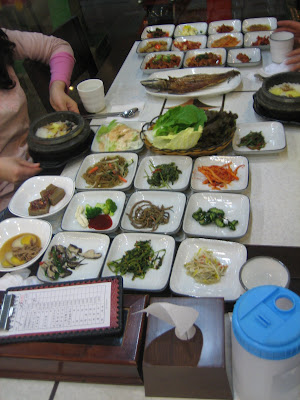
The side dishes were:
Sure, some of the side dishes are straight junk (Thousand Islands?) but for the experience alone this place is well worth the eight grand. Plus you get all the plum juice and shikhye (kind of a sweetened rice juice, with rice still floating in it) you can drink.
This restaurant takes its name from the town of Icheon, once the farming region from which the Kings of the Joseon Dynasty's rice came. The hypse would seem to suggest some kind of superior quality to the land in Icheon, some salient geomantic advantage for the region or perhaps an ancient pact between the king and the local leaders, but most people believe that the Kings sourced their rice from Icheon because it wasn't too far from Seoul. Ssalbap means rice: Korea has two distinct words for uncooked rice (ssal, pronounced sort of like the name Sol) and cooked rice (bap, pronounced like bop). So ssalbap translates to "ricerice". Anyway, the restaurant's official name is The King's Icheon Ssalbap (임금님의 이천 쌀밥), but folks round these parts usually drop the King.
Truth be told, nobody goes to this restaurant for the rice. After all, not being far from Seoul is no longer a marketing advantage for rice growers, and I suspect a large portion of the CO2 that the rice paddies in question consume comes out of tailpipes. The rice is cooked in a stone pot, and then scooped into a bowl. Hot water is added to the stone pot, where the rice that's scorched onto the red hot bowl soaks in the water and creates a palate cleansing chunky tea called nurungji (누룽지, sometimes translated as 'scorched rice') to be enjoyed at the end of the meal. The real draw here is the side dishes. For 8,000 won apiece (about $8), my wife, mother-in-law and I enjoyed 24 side dishes, a large broiled fish, crab soup , poached egg and kimchi jjigae (all three not pictured) and lettuce and cabbage leaves for wrapping.
The side dishes were:
pulled pork and boiled egg
japchae
spinach
fiddleheads
lettuce with Thousand Islands dressing
pork
beef
sweet and sour pork
bean sprouts
shiitake mushrooms
kimchi
garlic stalks
dotori (acorn) muk
doraji (Chinese bellflower root)
potato salad
steamed octopus and broccoli with vinegared red pepper paste fer dippin' (tastes alot better than it sounds)
Sure, some of the side dishes are straight junk (Thousand Islands?) but for the experience alone this place is well worth the eight grand. Plus you get all the plum juice and shikhye (kind of a sweetened rice juice, with rice still floating in it) you can drink.
Saturday, April 14, 2007
Cool things Korean (part 3)
Sutamyun
The other day Miyoung and I were on our way home from work and looking for a place to eat. She suggested the food court in the basement of the GS Square department store, and who am I to say no? Actually I know that mall and department store food courts in Korea are some of the best places to eat around. Rather than being made uniform by the presence of chains like the U.S., the Korean food court consists of nameless kitchens, each with its own specialty. In fact, some of my favorite places to get certain foods are in food courts. We had never been to this food court before, so we ordered an old standby, jajangmyun (or jjajangmyun, 자장면). Jajangmyun is basically noodles (myun) and jajang sauce, which is a heady black mixture of fermented black bean paste, onions, a little potato and carrot and whatever else granny's recipe calls for. Very savory, very delicious, jajangmyun is beloved by children, who can often be seen with black smears at the corner of their mouth. I neglected to take a picture of the food in my zeal to eat it, so here's a stock photo.
 Interesting side note about the word 'myun'. This is the Korean pronunciation of the Chinese word for noodles (originally meaning 'flour') that spread throughout Asia and even into America. Perhaps you've had chow mein? Same word: in Mandarin chao mian means fried noodles. How about ramen? Men is the Japanese pronunciation of this word. They all share the same Chinese character.
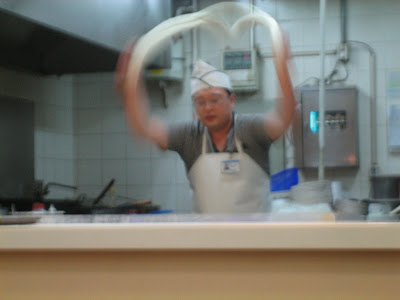
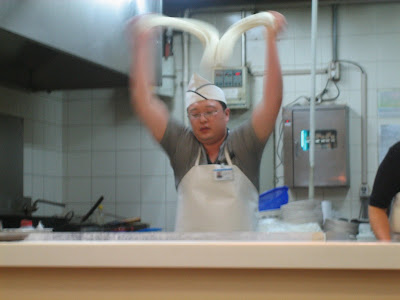
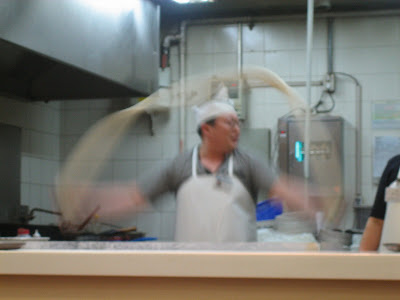
What we didn't realize when we ordered was that this kitchen was serving suta jajangmyun. Suta literally means 'hand beaten'. We had a seat next to the kitchen, and we saw the cook readying a big wad of dough and knew what was coming, but the lady next to us didn't see. The cook pulled the dough apart and loudly thwacked it down on the floured counter. The woman must have jumped a foot.
The whole point of all the thwacking is to pull the wad of dough to double its length, so you can fold it over and thwack it again. Do this ten or fifteen times and instead of holding a wad of dough, you've got two or three servings of noodles in your hand. Watching an expert tease these noodles out to their full length is amazing.


Incidentally, this was served with the best jajang sauce I've ever had. So if you ever happen to be in the GS Square Department Store in Bucheon, go down into the basement and order a bowl of jajangmyun.
The other day Miyoung and I were on our way home from work and looking for a place to eat. She suggested the food court in the basement of the GS Square department store, and who am I to say no? Actually I know that mall and department store food courts in Korea are some of the best places to eat around. Rather than being made uniform by the presence of chains like the U.S., the Korean food court consists of nameless kitchens, each with its own specialty. In fact, some of my favorite places to get certain foods are in food courts. We had never been to this food court before, so we ordered an old standby, jajangmyun (or jjajangmyun, 자장면). Jajangmyun is basically noodles (myun) and jajang sauce, which is a heady black mixture of fermented black bean paste, onions, a little potato and carrot and whatever else granny's recipe calls for. Very savory, very delicious, jajangmyun is beloved by children, who can often be seen with black smears at the corner of their mouth. I neglected to take a picture of the food in my zeal to eat it, so here's a stock photo.
Interesting side note about the word 'myun'. This is the Korean pronunciation of the Chinese word for noodles (originally meaning 'flour') that spread throughout Asia and even into America. Perhaps you've had chow mein? Same word: in Mandarin chao mian means fried noodles. How about ramen? Men is the Japanese pronunciation of this word. They all share the same Chinese character.What we didn't realize when we ordered was that this kitchen was serving suta jajangmyun. Suta literally means 'hand beaten'. We had a seat next to the kitchen, and we saw the cook readying a big wad of dough and knew what was coming, but the lady next to us didn't see. The cook pulled the dough apart and loudly thwacked it down on the floured counter. The woman must have jumped a foot.
The whole point of all the thwacking is to pull the wad of dough to double its length, so you can fold it over and thwack it again. Do this ten or fifteen times and instead of holding a wad of dough, you've got two or three servings of noodles in your hand. Watching an expert tease these noodles out to their full length is amazing.
Incidentally, this was served with the best jajang sauce I've ever had. So if you ever happen to be in the GS Square Department Store in Bucheon, go down into the basement and order a bowl of jajangmyun.
Tuesday, April 03, 2007
Cool things Korean (part 1)
There are times when those living in Korea are faced with the question "What am I doing here?" One of the best examples of such a time is during the early spring "yellow dust" season during which Korea is blanketed with, um, yellow dust from China's recently deforested desert region. Thanks China!
1. Corn Ice Cream
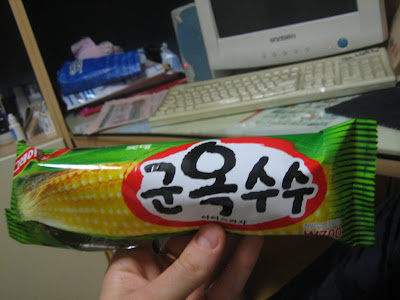
I'm talking about the Gunoksusu corn ice cream bar. a thick tube of corn ice cream with real corn niblets churned right in, wrapped in a thin layer of chocolate and ensconced in a soft corn-shaped wafer, giving it a strong resemblance to an actual ear of corn. Here's the wrapper
And here's a cross-section.
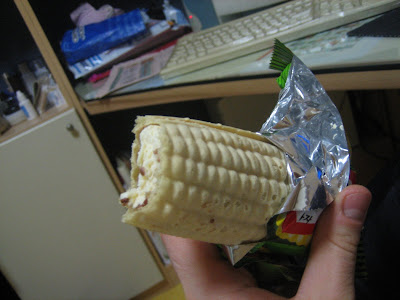
Unfortunately I was not able to coax a niblet to the surface to be photographed, but imagine a soft, chewy piece of corn in chilly corny ice cream. Makes all that severe respiratory risk worthwhile.
2. T Money
Actually the whole concept of proximity cards. So you want to ride the bus or subway? Get yourself a transit card, either a credit card with transit card capabilities or a debit transit card, and you never have to take it out of your wallet or purse. When you go through the turnstyle or get in the bus, just slap your whole wallet or bag onto the T Money thingy and it will deduct the appropriate amount from your account or charge you. Better still, when you get off the bus to transfer, slap that puppy on there again and it'll automatically discount your transfer.
But the single coolest thing about the whole proximity technology is that it's not limited to cards.
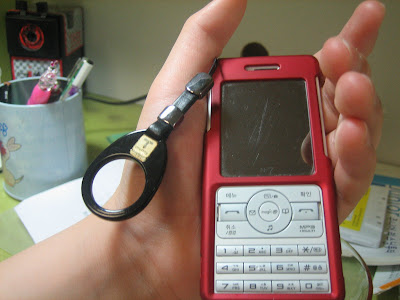
That's my student Ucheol's phone, and the little black cell phone bauble to the left is his T Money card. See the little gold T on there? It's smaller than a ring pop for crying out loud!
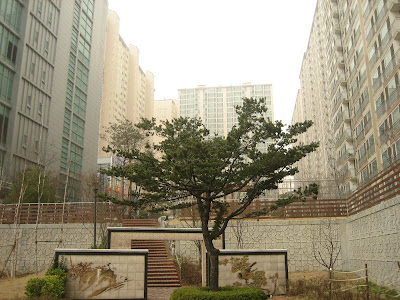
I was taking a picture of the tree but check out that yellow dust. This was ten o'clock Sunday morning.
And so when faced with media hysteria about yellow dust, I am left seeking justifications for my continued presence in a country in eminent danger of being completely plowed under by fine particulate matter. Here's what I came up with.1. Corn Ice Cream
I'm talking about the Gunoksusu corn ice cream bar. a thick tube of corn ice cream with real corn niblets churned right in, wrapped in a thin layer of chocolate and ensconced in a soft corn-shaped wafer, giving it a strong resemblance to an actual ear of corn. Here's the wrapper
And here's a cross-section.
Unfortunately I was not able to coax a niblet to the surface to be photographed, but imagine a soft, chewy piece of corn in chilly corny ice cream. Makes all that severe respiratory risk worthwhile.
2. T Money
Actually the whole concept of proximity cards. So you want to ride the bus or subway? Get yourself a transit card, either a credit card with transit card capabilities or a debit transit card, and you never have to take it out of your wallet or purse. When you go through the turnstyle or get in the bus, just slap your whole wallet or bag onto the T Money thingy and it will deduct the appropriate amount from your account or charge you. Better still, when you get off the bus to transfer, slap that puppy on there again and it'll automatically discount your transfer.
But the single coolest thing about the whole proximity technology is that it's not limited to cards.
That's my student Ucheol's phone, and the little black cell phone bauble to the left is his T Money card. See the little gold T on there? It's smaller than a ring pop for crying out loud!
Subscribe to:
Posts (Atom)
