안녕하세요. 리빙 인 코리아 MP3 다운 받으세요.
쩌우 먼델로 - 리빙 인 코리아
지난 4년반 동안 한국에서 잘살았습니다.
내가 한국에서 제일 즐긴것 중에 몇개 뽑아서 이 노래를 만들었습니다.
Download 'Living in Korea
Joe Mondello - Living in Korea
For the past four and a half years I have lived in Korea. This is a song about some of my favorite Korean things. Enjoy!
Showing posts with label korea. Show all posts
Showing posts with label korea. Show all posts
Friday, August 15, 2008

Wednesday, December 05, 2007
To: Metropolitician Re: Yr Proposal . . . I do!!
Ah, Metropolitician! A passionate man with strong opinions, and I like that. I just read his proposal for a new 'elite visa' for long-time, well-behaved English teachers intended to increase demand for better teachers, improve the treatment of English teachers by school owners, and reward good teachers with more rights in order that they may 'take a bigger part in Korean life'. Since my comment is longer than eighty percent of my blog posts, I figured I'd reprint my comment here, for my own reference and yours.
Re: A Realistic Proposal
I find it highly unrealistic that anything will be made of this proposal for several reasons.
Re: A Realistic Proposal
I find it highly unrealistic that anything will be made of this proposal for several reasons.
- First of all, all your proposed system does is make life easier for foreign English teachers living long-term in Korea. It fails to address the supposed threats that foreign teachers pose to Korean students and Korean society. What good is making life easier for English teachers who've been in Korea for three or more years without doing anything about shorter-term teachers, transients with no ties to Korea? This is like reacting to a tainted beef scandal by introducing a new super-premium Grade Double-A beef designation. It simply doesn't address the problem at hand.
- Second, the whole proposal's a crazy quilt of unrelated gripes that leaves a bad taste in one's mouth. What Korean would want to read a constellation of complaints about topics as diverse as the Busan amateur theater bust, the guy from the Host getting deported, the way foreigners are treated like 'walking dictionaries', and the illegal black list. Few Koreans would have any idea what half of these incidents were about.
- Third, your focus on yourself and F-4 visa holders in general as a standard of comparison is confusing. First of all, your mother is Korean, which, like it or not, matters in Korea and will continue to do so. It remains to you to explain to Koreans why any foreigners should have the luxury of choosing to quit and work multiple jobs at will, because the benefit to students is not as intuitive as you may think it is.
- Finally, and most important, this proposal fails to make it clear why Koreans should care about the foreign teachers' legal status. From their point of view, English teachers have a pretty good deal. They are in the country to teach English and they are paid handsomely for it. This proposal describes the following benefits for Koreans should they choose to follow it:
- Fewer foreigners will go back to their home countries with hagwon hell stories.
- More poetry, art, and exhibitions in the foreigner community.
- Foreigners taking a bigger part in Korean life.
- Perceived crime and drug use by foreigners.
- Unqualified teachers.
I would say that taken together, the strident tone, poorly reasoned premise, and ineffectualness of the proposal itself will probably turn off most of the people who read it.
Now if you could come up with a proposal for a visa reform which would provide tangible improvements for Korean English learners and Korean society as a whole while at the same time insuring better conditions for good teachers and weeding out the bad, then I would say you're on the right track.
Monday, December 03, 2007
Why did I never hear this in Korea?
This (courtesy of Slate) is the kind of factoid I came to expect in Korea:
Go read the whole unflinching article.
[K]ids adopted from Korea outscored the U.S. average by two to 12 points, depending on their degree of malnutrition. In a third study, Korean kids adopted in Belgium outscored the Belgian average by at least 10 points, regardless of their adoptive parents' socioeconomic status.
Go read the whole unflinching article.
Sunday, November 25, 2007
Inside vs Outside
Here are two great quotes that go great together. The first is from an essay about Korean culture's propensity do define the world in terms of 'in' (friends and family, allies) versus 'out' (strangers)
Although the author, Yonsei University professor Horace Underwood, focuses specifically on students, the analysis extends to all aspects of Korean society. At the risk of offending some, I would say it makes Koreans excellent friends, only so-so citizens and, when you're walking down the streets of Korea, particularly aggressive obstacles. To extend Underwood's 'in and out' analysis, one has to go no further than the typical Korean home, the high-rise apartment building, which looks like this on the outside

and this on the inside.

Korean homes are typically very clean. The floors clean enough to eat off, unnecessary clutter usually banished to drawers and well-organized shelfs.

The outside of the typical Korean apartment block practically screams to the average American "Yes, we sell crack!", filthy and never ever cleaned, with rust stains streaking the walls and small cracks spackled over in white, emphasizing the building's age, (perhaps to drive down the apartment prices), never letting on the tidy little family lives going on therein.
Now here's a quote from a Slate article about the various re-edits of the Spielberg film Close Encounters of the Third Kind.
It turns out that all sorts of things in Korean society are explained by this distinction between "in" and "out." . . . "In and out" explains why Korean students are so clean in their homes and so likely to throw trash in the campus streets - the street is outside their area, the territory of non-persons. The distinction is reinforced by taking off shoes in a house; the house is clean space, while "out" is for shoes, dirty.
Although the author, Yonsei University professor Horace Underwood, focuses specifically on students, the analysis extends to all aspects of Korean society. At the risk of offending some, I would say it makes Koreans excellent friends, only so-so citizens and, when you're walking down the streets of Korea, particularly aggressive obstacles. To extend Underwood's 'in and out' analysis, one has to go no further than the typical Korean home, the high-rise apartment building, which looks like this on the outside

and this on the inside.

Korean homes are typically very clean. The floors clean enough to eat off, unnecessary clutter usually banished to drawers and well-organized shelfs.

The outside of the typical Korean apartment block practically screams to the average American "Yes, we sell crack!", filthy and never ever cleaned, with rust stains streaking the walls and small cracks spackled over in white, emphasizing the building's age, (perhaps to drive down the apartment prices), never letting on the tidy little family lives going on therein.
Now here's a quote from a Slate article about the various re-edits of the Spielberg film Close Encounters of the Third Kind.
We see suburban Muncie as a sprawl of carefully arranged, nearly identical houses stretched out beneath a starry sky. But within those tidy houses, Spielberg finds chaos. Clutter piles on top of clutter in a family room that can barely contain its family. Conversations overlap but fail to drown out the television's blare. And at the center of it all is a man already half-mad from all the commotion, unable to focus on his toy trains and stuck with a family unable to appreciate the whimsy of Pinocchio.
According to Underwood, Spielberg's protagonists would be living inside out.
Saturday, October 20, 2007
Newest American trend to hit Korea: calling dudes gay
This blows my mind. Effeminate Korean singer Brian from duo Fly to the Sky
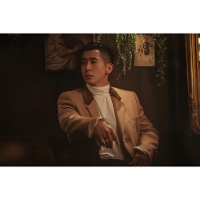
goes on Gag Concert, only to be ragged on by has-been singer Lee Sang-won

for being gay. My translations are based on this article from Sports Chosun.
Lee then ordered Brian to do push-ups to prove his manhood.
Now what I want to know is where Lee Sang-won got this homophobic gay-bashing attitude from. It's one of America's most unsavory distinguishing characteristics and I've long cited its absence from Korea as a definite point in its favor (Not that it means Korea's any more enlightened about homosexuality than the U.S.)
I suspect that the audience watching Gag Concert that night was very perplexed by the attack. I mean, Korea is the land of the pink shirt, and whether or not Korean men are more in touch with their feminine side because they don't believe in the existence of Korean homosexuals, it remains true that Korean men can act in a manner that would get them brutally teased in the U.S. without fear of recrimination.
I don't know whether Lee Sang-won learned to be made insecure by other men during years of has-been exile in America or what, but I sincerely hope that his nasty sniping doesn't rub off on any impressionable Korean kids.
goes on Gag Concert, only to be ragged on by has-been singer Lee Sang-won
for being gay. My translations are based on this article from Sports Chosun.
Lee: Where did all the talk of you cross-dressing and dating [Fly to the
Sky bandmate Eru] come from?
Brian: It's a misunderstanding due to the fact that we're so close. And sometimes I go to hang out at Eru's house and
sleep over.
Lee: [Older entertainer] Tae Jin-a always says you're so pretty . . .
Brian: Of course. I think of myself as his son.
Lee: Do you think of yourself as his son or daughter-in-law?
Lee then ordered Brian to do push-ups to prove his manhood.
Now what I want to know is where Lee Sang-won got this homophobic gay-bashing attitude from. It's one of America's most unsavory distinguishing characteristics and I've long cited its absence from Korea as a definite point in its favor (Not that it means Korea's any more enlightened about homosexuality than the U.S.)
I suspect that the audience watching Gag Concert that night was very perplexed by the attack. I mean, Korea is the land of the pink shirt, and whether or not Korean men are more in touch with their feminine side because they don't believe in the existence of Korean homosexuals, it remains true that Korean men can act in a manner that would get them brutally teased in the U.S. without fear of recrimination.
I don't know whether Lee Sang-won learned to be made insecure by other men during years of has-been exile in America or what, but I sincerely hope that his nasty sniping doesn't rub off on any impressionable Korean kids.
Monday, October 15, 2007
A super-easy Korean side dish
On Saturday my wife, mother and I went to Flushing, New York for my cousin's borthday. My Uncle and two cousins took us into Koreatown to go shopping. The two things Miyoung jumped at were cucumber kimchi and odeng.
Actually Eomuk. The Hanareum Mart that we went to had plenty of girls and ajummas giving out free samples, and the girl doling out the Busan Eomuk and I had a passionate discussion about the difference between odeng and eomuk and the proper English term for it. 'Is it fish paste?' Her sign said 'fish cake', which I know isn't technically correct but is much more appetizing. It seems to us that both fish paste and fish cake are misnomers, but what are the other options? Fish Roll-up? Fish sheets?
As you may well know, odeng is considered an import from Japan, while eomuk, associated most closely with Busan, is the 'original Korean article'. I would say in general eomuk is somewhat softer and spongy than odeng, but otherwise tastes the same.
Anyway, today I've got a nice easy recipe for fried odeng/eomuk.
First get your nice sheets of odeng/eomuk.
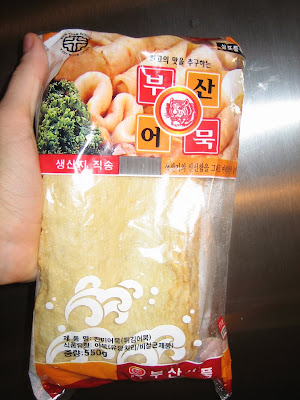
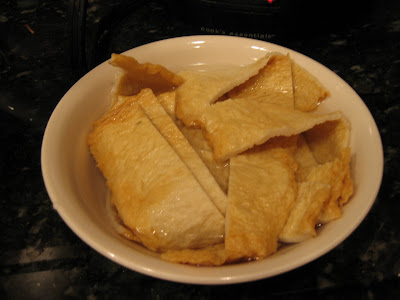
Slice it into whatever shape you like, rinse and soak it in hot water to release some of the grease and delicious saturated fat.
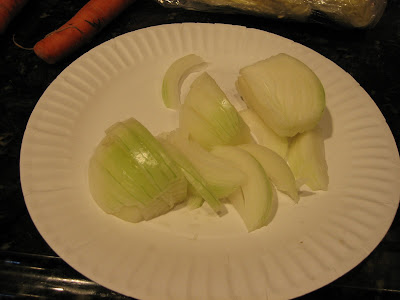
Slice up a nice onion.
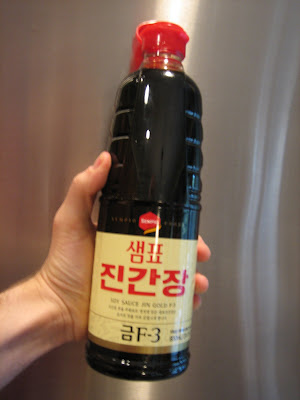
Get out your soy sauce. I recommend Korean 'Jin' Soy Sauce (진간장) You'll need about a tablespoon.
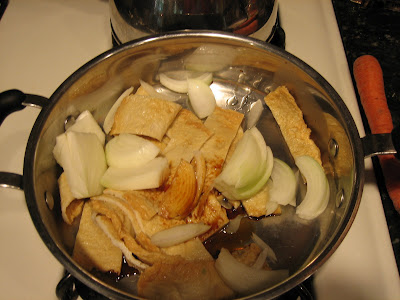
Put a tablespoon of olive oil in a frying pan and add the cut odeng/eomuk, the sliced onion, the soy sauce and about a tablespoon of sugar
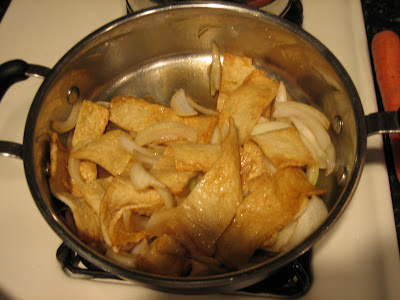
Fry it up until it looks like this.
That'll last you about three days if you're Korean or, if you want to eat it American-ly, it won't be enough for one meal.
Enjoy.
Actually Eomuk. The Hanareum Mart that we went to had plenty of girls and ajummas giving out free samples, and the girl doling out the Busan Eomuk and I had a passionate discussion about the difference between odeng and eomuk and the proper English term for it. 'Is it fish paste?' Her sign said 'fish cake', which I know isn't technically correct but is much more appetizing. It seems to us that both fish paste and fish cake are misnomers, but what are the other options? Fish Roll-up? Fish sheets?
As you may well know, odeng is considered an import from Japan, while eomuk, associated most closely with Busan, is the 'original Korean article'. I would say in general eomuk is somewhat softer and spongy than odeng, but otherwise tastes the same.
Anyway, today I've got a nice easy recipe for fried odeng/eomuk.
First get your nice sheets of odeng/eomuk.
Slice it into whatever shape you like, rinse and soak it in hot water to release some of the grease and delicious saturated fat.
Slice up a nice onion.
Get out your soy sauce. I recommend Korean 'Jin' Soy Sauce (진간장) You'll need about a tablespoon.
Put a tablespoon of olive oil in a frying pan and add the cut odeng/eomuk, the sliced onion, the soy sauce and about a tablespoon of sugar
Fry it up until it looks like this.
That'll last you about three days if you're Korean or, if you want to eat it American-ly, it won't be enough for one meal.
Enjoy.
Saturday, October 06, 2007
My reaction to the new Inter-Korean Agreement in a nutshell
a) Roh Moo-hyun and his predecessor Kim Dae-jung and cohorts have created, in the Sunshine Policy, an atmosphere in which South Korea expects to reconcile with North Korea through dialogue Advances are touted by astute politicians while setbacks are studiously ignored.
b) As the Marmot points out, likely next president Lee Myeong-bak will be politically bound to go through with the joint plans made by Roh and Kim Jong-il. To not do so would be seen as unacceptable provocation.
c) As much of the joint projects will be funded by private industry (hat tip to the Marmot again), Korea's corporations will have a vested interest in both the international perception that North Korea is making progress and the continued cooperation of the Kim regime.
d) With both politicians and corporations in South Korea heavily invested in the perception of progress on the North-South issue, advances both real and imagined will be touted more vigourously while setbacks will be swept so far under the linoleum that it'll take the ondol extra long to heat up.
e) As for North Korea, they now recognize that pointing missiles at Seoul and threatening to turn the city into a lake of fire is no longer a viable means of extorting aid. It is both cheaper and easier to demilitarize while allowing the placement of South Korea's public and private sector's cherished symbols of peninsular unity to be built, at South Korean expense, in North Korea. Now, all North Korea needs to put South Korea in appeasement mode is close a plant or, in a kind of reverse Gazprom maneuver, close the South Korea-China train line. A master stroke, I must say.
Wednesday, October 03, 2007
A little Korean Jew-baiting for you

According to the Marmot, the Incheon residents who put up the banner
are upset about plans to develop their area into a tourism and leisure zone as part of the IFEZ project. Jack Rosen is reportedly a major player in the development project.
But lest you think this is a good old-fashioned Jewish conspiracy, rest assured that it is as Korean as aju-ma, baseball and giant/tasteless/mealy apple pie, the protesters' land was stolen from them and given to the foreign developer by (dun dun dunnn) the government.
Monday, October 01, 2007
It's a slightly less small world
I'm on vacation in Florida right now, and on line for the It's A Small World ride at the Magic Kingdom I realized that there was an extremely high chance that either a) there are no Koreans on the ride or b) there were some Korean dolls awkwardly shoehorned into the ride.
Upon entering the Asia room, I was prepared to have my first guess confirmed as I saw a stylized Chinese backdrop with a stylized Japanese backdrop right next to it. I know the picture below is dark, but Japan is on the left, China on the right, and the only thing between the two is the yellow bridge.
r look at the Chinese doll
Upon entering the Asia room, I was prepared to have my first guess confirmed as I saw a stylized Chinese backdrop with a stylized Japanese backdrop right next to it. I know the picture below is dark, but Japan is on the left, China on the right, and the only thing between the two is the yellow bridge.
 Continuing on, I instead saw that my second guess was in fact correct. The two Korean dolls in the place were placed far off from anything identifiably Korean on their own little stage.
 Now take a close look at the Chinese guy from the upper left hand corner of the above photo. He's very abstract and very typical of the Small World ride.
 Now have a gander at the two Korean dolls, dressed in their intricately detailed hanbok.
 They stick out like a sore thumb. These hanbok look like they're straight out of Dongdaemun Market. My wife says she saw two other Korean kids flying a kite, but I can't confirm that.
The last room the ride goes through has representatives of all the countries passed through wearing white and blue, angelic versions of their native garb. There there are no Korean dolls, although there are four Chinese dolls spinning plates and plenty of Japanese dolls too.
I suppose that, to make up for their sleight against Korea, Disney has included a sign in Korean among it's farewells (again, sorry so dark). A little closer now.

r look at the Chinese doll
Friday, September 28, 2007
Enriched beer
It's Always Sunny in Philadelphia has single-handedly made Korea, Korean barbecue, and Korea's famously delicious beer famous. Finally, Korea enters the ranks of developed parody-worthy nations. (See a woefully non-Korea-related clip here, and then go see if tv-links.co.uk has it up yet.)
Monday, August 27, 2007
This ought to raise eyebrows . . . oh, I guess not
I have a game for you. Watch this video of my favorite old man with sadly childish hairstyle and clothing, Boom (붐), interviewing 'singing' sensation Ivy (아이비). Now here's the game: count the number of times that Ivy's eyebrows move.
That's right, exactly once, at the 2:13 point. Once you notice that her forehead is huge and almost immobile, it becomes unavoidable to ask the following question. Is that her real forehead?
I have no idea, and I don't care. What I am interested in is these forms of plastic surgery focused on the face that are moving the Korean beauty ideal further and further away from what the majority of Koreans actually look like. I would say the best treatment of this topic in a blog can be found over at the Metropolitician's site. He shows how the Korean beauty ideal has changed over time, from realistic to elfin, Asian to Hyrulian.

I chose Hong Su-a as an example of the new standard of beauty in Korea (slender face, surprisingly big nose), but doing so is probably understating the situation, as she is one of the only female mainstream entertainment figures who hasn't had eyelid surgery
First off, yes, forehead implants are real. Here are some before-and-after photos.
 Next on the chopping block are prominent cheekbones, a very common feature in Korea that many here find unattractive. I've even had people explain to me seriously that they are a result of malnourishment, which is why they are more common in older generations and in North Korea than in younger South Koreans. I don't know if malnutrition causes the condition, but I know what cures it: hot steel.

Here's the commercial that popularized the phrase "V line face", which refers to a narrow, V-shaped jawline.
The commercial states "V-line is fashion, the future, envy, V-line is Gwangdong Corn Silk Tea" (yes, it's really a commercial for tea made of an agricultural

The future (right). Left: the past
And here's one woman who's totally stuck in the past Jes' joshin', Kyoung-lim Nuna.
I blame the simple economics of supply and demand to some extent. There are plenty of girls with strong jawlines and not so prominent foreheads. but it seems to me that in this case the very lack of supply creates the demand. Truth be told, I'm just spit-balling here, because I don't want to go and say something that's completely off the wall.
When will the hurting stop?
I have a bit of a theory about Korean culture that I would like to elaborate on. I doubt that I am the first person to come up with this concept, but I am beginning to find it an inescapable conclusion, which means that I am perhaps becoming too biased to judge whether my own idea actually makes sense. So let me know if you think it's all wrong.
The concept came to me when I was reading about gang initiations. Many gangs initiate their new members by making them commit a crime. The initiate subsequently feels a bond of shared guilt with his fellow gang members, who have commited the same crime. This shared guilt bonds gang members together tightly.
Now what I'm saying is that Korean society acts in a similar fashion, but instead of a bond of shared guilt, I believe that Koreans are brought together by a bond of shared discomfort.
Where did this theory come from? I noticed that, while people in Korea do a lot of things that are pleasurable, there is usually some extra something thrown into the mix that is unpleasant. Communally unpleasant. When you eat Korean food, the first thing that you are struck by is the spiciness. You ask yourself "Why must everything we eat be spicy?" and even if, like many non-Koreans, you like spicy food, you are confronted with the basket on the table containing carrots, cucumbers and green peppers. You eat the carrots, eat the cucumbers, and then someone tastes the pepper, gingerly at first but then quicker. "It's ok, they're not spicy!" that person reassures you, so you grab the other pepper and bite into it. It must be from a different batch, because it is burning the enamel off your teeth. It's like Russian roulette with food.
 Or you can go in for the guaranteed torture that is buldak (fire chicken).

Buldak is another shared adventure in masochism. You and your friends go to the buldak restaurant to suffer through a painful chemical burn together, with the added bonus of a vaguely charcoal-y scent and a chicken-y chew. There is nothing to recommend buldak except the oft-repeated claim that 'spicy food is addictive.'
Do you know what happens if you blow your ear drums out listening to your headphones? Or if you develop a dependency on a drug? You require an increasing amount of these inputs to feel satisfied, because you've dulled your senses. Imagine how much a lifetime of eating spicy food dulls your senses.
It is a well known fact that Korean workers go home only when their bosses go home. If the boss stays till 9pm, that pretty much means that everybody is staying till 9:01. I usually hear people explain this in terms of the boss. "Oh, you mustn't leave before your boss." I disagree. I believe the true point of everybody waiting for the boss is everybody waiting together. Everybody missing dinner with their families and knowing that that's what everybody in every office in Korea is doing has a real effect on the national psychology. How can you help but think 'We are a hardcore nation.'
Drinking alcohol is commonly agreed upon in most cultures to be an agreeable recreational experience. Those who drink alcohol typically do it to loosen up and relax, to let their guards down, and to facilitate socialization.
Koreans are no different, in intent, however it is the degree to which the drinking takes place that makes it, for many, a painful experience. Most of the participants in drinking sessions are not in control of the amount that they wind up drinking. That is decided by whoever is running the party, usually a boss or the oldest person at the table. Blacking out and vomiting are common experiences for some. What should be a fun activity becomes a brutal slog mandated from above. Everyone in the drinking party is bound by the will of the senior member to drink, sing and be merry or else face ostracism.
Some office girls, chugging as though their jobs depended on it
Again, we see singing, at times a pleasurable experience, turned into a painful social tool, like a hammer. Public singing becomes another bond, this time one of shared humiliation. Bear your soul or else. Again, this is not always the case, but it takes on this unpleasant dimension in the context of forced socializing.
What's next? Why it's on to stage 3, for some real bonding through shared guilt. This time the guilt of adultery. What could create more convivial feelings than sullying your marriage vows with some guys from work? Some whiskey, women and song will guarantee that you and Team Leader Choi will remain close business contacts forever!
Finally, what form do the most popular Korean television shows take? Celebrity humiliation, in which Korea's most famous TV personalities have to suffer hilarious indignities. In the show shown below, celebrities have to memorize a song and sing it perfectly, at the risk of having a pan dropped on their head (HT to James at The Grand Narrative for finding the Youtube clip).
Although the most popular current incarnation of bonding through shared suffering theater is Old Time TV (옛날TV), in which entertainers must perform such feats as pulling the tablecloth out from under a stack of bowls at the risk of having 100 liters of water dropped on them and having to memorize and sing a song while trapped inside a sauna, being allowed out only if they can sing the song perfectly.
Tuesday, August 21, 2007
If the UN says so . . .
The UN has told Korea it ought to drop its cherished self-identification as a pure-blooded race.
This is, of course, one of these stupid old ideas created for nationalist purposes that people in Korea carry on without thinking about whether or not they make any sense. While many Koreans do believe this to be true, most of the smart people I know know it to be ridiculous, and I have often heard the opposite "Korea is a rich purée of other groups that has simply had the lumps blended out" view, citing ancient immigrantion from countries as far afield as India and Vietnam, and of course Mongolia, whence Korean babies are said to get their famed 'Mongol spot'.
Meeting in Geneva from July 30 until Aug. 17, the 71st UNCERD reviewed national reports on Costa Rica, New Zealand, Mozambique, Indonesia, and South Korea and released recommendations for them. On Aug. 9-10, it looked into reports submitted by the South Korean government. In the recommendations, UNCERD expressed discomfort about a prevalent notion in Korean culture of "pure-bloodedness," saying, "The whole concept came very close to ideas of racial superiority."
This is, of course, one of these stupid old ideas created for nationalist purposes that people in Korea carry on without thinking about whether or not they make any sense. While many Koreans do believe this to be true, most of the smart people I know know it to be ridiculous, and I have often heard the opposite "Korea is a rich purée of other groups that has simply had the lumps blended out" view, citing ancient immigrantion from countries as far afield as India and Vietnam, and of course Mongolia, whence Korean babies are said to get their famed 'Mongol spot'.
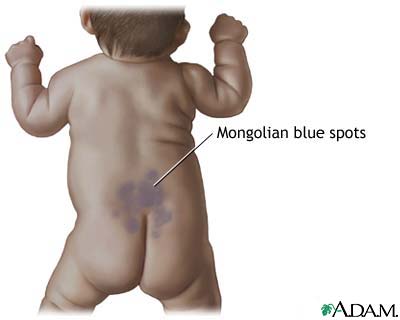 Which many Koreans will tell you only occurs in Mongolians and their close cousins, the Koreans, although this is patently false.
Anyway, yeah, can the pure-bloodedness fairytale, Korea.
Update: The Marmot has a detailed breakdown of exactly the information I have heard about immigrants throughout Korea's history
Thursday, August 16, 2007
I would like to thank the following people and institutions
for making my time in Korea what it was
- My first boss in Korea, for giving me money that he knew he didn't owe me when I quit my job at his school because of the breach of contract that I believed he was responsible for. I later learned that he had been treating his teachers better than the average boss by far.
- Kim Eunjung from Jangseungbaegi station and her mother, who let me stay in her house until I got a new job.
- Beomjeong, for introducing me to my wife.
- The Korean education system, for being woefully inadequite and creating the system in which I worked.
- The makers of Bbungeobbang ice cream.
- My wife's family, for treating me so well.
- The fine people of Bucheon city.
- Greg, for introducing me to my first job in Bucheon, and for later coming to work part time at our school.
- The good folks down at the Financial Supervisory Service, whom I taught and from whom I learned a lot.
- Confucius
Thursday, August 09, 2007
I am leaving Korea in a week
And I can honestly say that I will miss it much more than I ever missed America. Why?
I suppose the reason is that I have America inside me. If I had to I could probably make America over again, but Korea will forever be an outside influence on me, no matter how much I've internalized.
Perfect example, I just wrote 'nomatter' as a single word, apparently my subconscious brain's translation from one Korean word (아무리) to English.
There are so many things to worry about. I lost 180 pounds in Korea. Will returning to America put me back on my diet for death? Will I forget massive amounts of my hard-won Korean? Will I lose touch with the culture? Will I forget all the important lessons about people that I learned here?
And then there are the regrets. There are those who've spent their time in Korea mining its history for wisdom. There are those who've spent it having fun, blissfully unaware of the world going on around them. There are those who've spent their time in Korea viciously poking holes in the hypocrisy, the illogic, the foolishness that one finds here. I have spent my small time here trying to really understand the world as modern Koreans see it. I effectively walled myself off from the non-Korean world. In 2006 I spoke face-to-face with non-Koreans less than 10 times. The Japanese colonial period, the Yangbans and the early Christian missionaries are as far from me as they are to the average Korean man on the street, but it is a rare trend or buzzword that I have not heard about.
I believe in secular humanism, a world without a god in which people have been created in the forge of evolution for no particular purpose and culture is a mere element of our extended phenotype. To the extent that I believe the past effects the present, I don't think things systematically forgotten or dumbed down to a nub have any bearing on the present and thus I am not a huge fan of history as a window on the present. When I view the Koreans of today I see them as products of their environment, and that environment a product of history, a crucial distinction. When I came here I wanted to feel what Koreans feel and know what Koreans know, unhampered by half-baked connections to the past. Korea is often a country of pure emotion,and to approach it on any other level seemed and still seems foolish to me. To try to use facts in a way in which they are not used in Korea seems silly and almost (gulp) imperialistic. Now is a time for me to look back and think seriously about whether I have made the right decision, whether I have seen what I wanted to see and taken away what I wanted to take away.
I have managed in my time here to stretch my mind more than I ever thought possible. I have come to understand mindsets that I once ridiculed and among those I have even found those that I accept. Through it all I have not lost my own perspective, not become like putty that can take any form and has none to call its own. I have been able to call a spade a spade and to see when I was wrong.
Coming to Korea was the best thing that ever happened to me. Anyone that knew me will tell you so, and yet when I came here I had no idea that it would wind up this way. How much of this is Korea and how much of this is the natural process of an arrested adolescent becoming a man? This is impossible to answer and perhaps doesn't deserve one. Had I gone to China would I now be extolling the great reformative effect of Chinese culture on me? Impossible to say.
What I can say with some certainty is that I have learned far more in Korea than I ever set out to or even knew to set out to. I learned to suffer fools, and as much as that would enrage the high school, OK Computer-listening boy I once was, that is a valuable skill. I learned both the power of being on the outside and exempt from society's rules and the power that comes from being an insider and being bound to those rules. I learned how to function in a society I never thought I would have more than a fleeting relationship and I learned respect for people whose lives are as different from those I grew up around as possible.
So did I make the right choice? Should I have been visiting historical sites, dabbling in some University arts scene or hunting girls in Itaewon? Would I have better spent my time snowboarding, studying Joseon-period documents or lecturing every Korean that I met about what's wrong with their country? Or might I have been better off just cocooning myself off from the country altogether, meeting my foreigner friends every night of the week and otherwise behaving like a jolly colonial git?
I honestly don't know, although I have a strong suspicion that I have made the right decision. Every kind of expat in Korea that I have described is a real person and I would love to hear what they think, but with this blog's readership I don't see that happening.
Korea is a complicated place. It is so easy to peg it as any one thing that it is not, and to paint roll it with any label that you want. It's like Ireland. It's like Italy. It's like Cold War-era Germany, it's an agrarian blah blah but the people all blahed, It's the best example of American nation building, it's whatever your heart desires.
But it's not any of those things. I won't even attempt to say what it is. That's a fool's errand, and since coming to Korea one of the things I've learned is not to answer every question that's put to me.
Tuesday, August 07, 2007
The exquisite pain of Korean victimhood
Here is a short list of ways in which Korea's obsession with victimhood manifests itself
- In daytime dramas which center around a woman with a dopey victim-y hairstyle being cruelly mistreated and suffering through it passively (문희, 금순이).
- In historical films in which the main characters are helpless victims of historical circumstances passively tossed about by the viscissitudes of the time.
- In hysterical news reports about foreign English teachers come to Korea to have sex with Korean women.
- In hysterical news reports about foreign investors carting off steamer trunks full of money while leaving nothing behind for the Koreans.
- In Korean American antisemitism.
- In hysterical news reports about foreign companies (Mercedes, Starbucks) selling their products at high prices in Korea.
Feel free to add your own.
Monday, August 06, 2007
Jeolla Province Trip day 1 of 4 (Bogil Island)
Miyoung and I just got back from our four day trip to Jeolla Province. It was a fantastic time, and there are a lot of beutiful things down there that I definitely recommend you see if you get a chance.
A lot of people bag on package tours. I consider this a form of time snobbery. Having enough time to just go and traipse around on your own and 'discover' things is always talked up like some kind of trailblazing heroic thing to do. The fact is that in most places, if you go there to wander around and discover new surprises around every corner you're going to spend a lot of time doing things that aren't that great. Miyoung and I only had two weeks left in Korea, so we didn't have the luxury of time, so Miyoung put together three local tours into one super-tour, and I have to say that it was great.
Thursday
Left home at 7:00, took a taxi to Bucheon station and caught the rapid train to Yongsan station. The DMB television that Miyoung's sister lent us for the trip was cool, but it repeatedly lost the signal on the subway ride. When we arrived at Yongsan we couldn't turn it off and had to reset it, at which point it mercifully died and we were free of it for the rest of the trip.
Took the 8:30 KTX to Mokpo station (목포역). KTX is Korea's version of the high speed train. It was my first time going to Mokpo but it still seemed to me that 3 and a half hours was on the long side for the trip. At Mokpo station we met up with our bus and went to a big old neighborhood restaurant near the station and had a kimchi jjigae (김치찌개). This was my first taste of Jeolla-do's famous food, which was in this case not that great; the kimchi was extremely salty and everything else was as it would be back at home.
Full of salt, we were ready to move on to Bogil Island (보길도 or Bogildo). That meant going to Land's End (땅끝), the place where South Jeolla Province goes from continuous landmass to archipelago. We had a smooth hour ride until we got to the area around Land's End Town (땅끝마을) which was fairly swarming with tourists. Dirty tourists. For all the talk of love for their country, Koreans by and large have little concept of their actual impact on it. To quote my mother-in-law as she watched a news report about dirty tourists "Koreans are dirty." There, see, I didn't say it, I quoted a Korean who said it. Anyway, the entire landscape of Land's End is encrusted with ice cream wrappers, beer bottles, overturned barbecues, etc. My wife would not have me taking pictures of people's garbage, but I think you get the drift just from my description.
After a 40 minute traffic snarl on the mountain road around Land's End (the retaining wall next to the road is covered with 'Jinuk wuz here'-style graffiti, leading me to believe that such traffic jams are not uncommon) we got to the ferry to Bogil Island. The weather was hot but magically not that hot, and I managed to stay miraculously sweat free even as we waited for the ferry about 20 minutes on te shade-free pier.

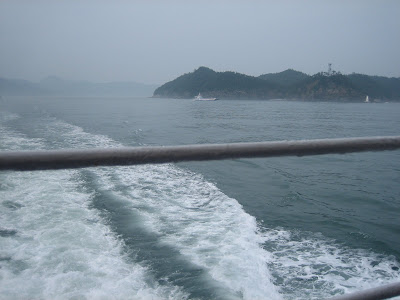
This is the view from the back of the ferry of one of the many islands making up Dadohe (다도해 or 多島海, The Sea of Many Islands, to put it somewhat inartfully). The weather remained similarly foggy throughout the entire trip
On our approach to the island I was shocked to see mile after mile of sea farms raising abalone and various forms of seaweed.
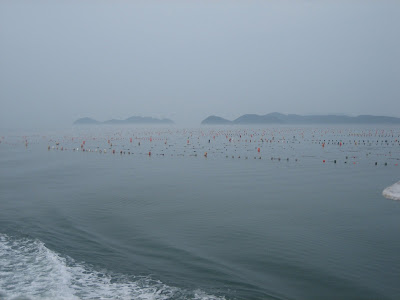
Just to give you some perspective, the ferry was flying along at a pretty fast clip, and I took the above and below photos about 10 minutes apart. In other words, the waters around the island are cultivated as far as the eye can see.

This bridge, which is not completed, connects the Bogil Island of leatherneck fisherman with the Bogil Island of pretty beaches, scenic spots, raw fish restaurants, and lily white Seoulites with pink T-shirts and old rural-to-urban transplants trying to reconnect with their roots.

The aforementioned Bogil town, where the restaurants serve kimbab, Chinese food, and spaghetti.
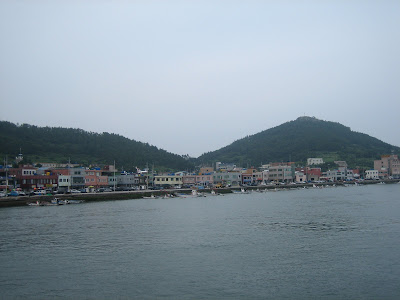
Tourist Bogildo, where the restaurants exclusively serve the frutti of the mare. Except this one Chinese restaurant that Miyoung went to once when she was a poor backpacker and had jajangmyun.

Upon arrival, unloading of our bus, reboarding of said bus we proceeded ten minutes along the shore to Jungri beach. There are other beaches on Bogil Island but this one, our guide says, is the best, and why would he lie?

The consistency of the beach was fantastic. The sand was so fine that the waves picked it up and got clouded with it, but the beach was also covered with seashells of all kinds, smashed to smithereens, presumably by the duel forces of nature and time or perhaps by seagulls. However while scrounging around the beach I found something I had never seen on a beach before: a shell that had somehow managed to not be completely picked clean by scavengers, still containing traces of its former occupants. This place is so laid back even the seagulls half-ass it.

We spent the night in a nice little guest house (민박). I was struck by the children of the owners who were lounging around enjoying their summer vacation. they had all the cards, comic books and other junk that my kids back in Bucheon had, plus super soakers, which they didn't have back in Bucheon, plus the beach and the mountains, plus they didn't seem to go to hagwons all summer, plus they didn't seem to be burdened by countrified accents that would someday serve to hold them back. And this was where they were spending their summer vacation.
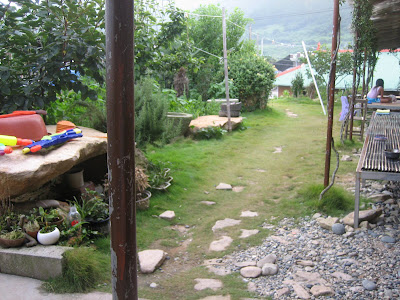
The rooms, by the way, were made of red earth (황토). This is believed by many (not me) to be good for you, and I heard more than once the bullshit detector needle burying, correlation and causation confounding statement "Long ago we lived in houses of red earth and we had no atopy (a kind of eczema), so buy this bottle of dirt/shirt dyed in dirt/makeup made of dirt/dirt cake/etc."
Anyway, after getting settled we went out to take some pictures at some scenic spots. The first one was some kind of promontory from which you could actually see Jeju Island on clear day. Of course this was a very very foggy day, so I just took pictures of my wife.
Wife and island

Wife and cliff face

Then we went to Dinosaur Egg Beach, which, despite being burdened with a stupid name, is one of the most interesting places we visited. Essentially a horseshoe-shaped beach with a round island in the middle, the shoreline is made up of large dinosaur egg-shaped rocks that make a satisfying sound when trod upon.

To the right of the beach is a beautiful bald hill.
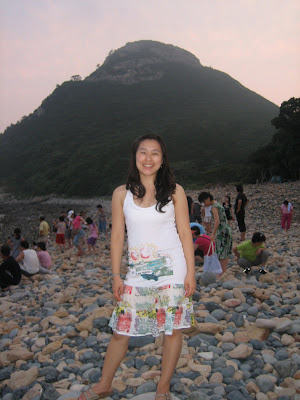
After taking pictures and having our feet scurried over by giant rock-dwelling bugs, it was time to go down to tourist town for a raw fish dinner. When the bus stopped, the tour guide said in a very off-hand way 'This is a good restaurant' while waving his hand in the general direction of the restaurant that the bus stopped directly in front of. I was shocked to see almost everyone on the bus dutifully file into the restaurant, and, ever the trailblazing package tourist, I insisted to Miyoung that we go to another restaurant. The result: just okay. The restaurant we wound up going to seemed very expensive, and the side dishes were nothing special. The fish, as was to be expected, was excellent, and included fresh raw wriggling octopus, sea cucumber and sea anemone (not wriggling, of course).
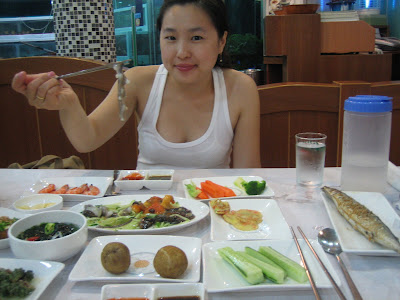
Oh, and potatoes. Jeolla Province seems pretty big on small potatoes.
Next Time: Adventure (and napping) on the high seas, grand temples, man-eating fish and more!
A lot of people bag on package tours. I consider this a form of time snobbery. Having enough time to just go and traipse around on your own and 'discover' things is always talked up like some kind of trailblazing heroic thing to do. The fact is that in most places, if you go there to wander around and discover new surprises around every corner you're going to spend a lot of time doing things that aren't that great. Miyoung and I only had two weeks left in Korea, so we didn't have the luxury of time, so Miyoung put together three local tours into one super-tour, and I have to say that it was great.
Thursday
Left home at 7:00, took a taxi to Bucheon station and caught the rapid train to Yongsan station. The DMB television that Miyoung's sister lent us for the trip was cool, but it repeatedly lost the signal on the subway ride. When we arrived at Yongsan we couldn't turn it off and had to reset it, at which point it mercifully died and we were free of it for the rest of the trip.
Took the 8:30 KTX to Mokpo station (목포역). KTX is Korea's version of the high speed train. It was my first time going to Mokpo but it still seemed to me that 3 and a half hours was on the long side for the trip. At Mokpo station we met up with our bus and went to a big old neighborhood restaurant near the station and had a kimchi jjigae (김치찌개). This was my first taste of Jeolla-do's famous food, which was in this case not that great; the kimchi was extremely salty and everything else was as it would be back at home.
Full of salt, we were ready to move on to Bogil Island (보길도 or Bogildo). That meant going to Land's End (땅끝), the place where South Jeolla Province goes from continuous landmass to archipelago. We had a smooth hour ride until we got to the area around Land's End Town (땅끝마을) which was fairly swarming with tourists. Dirty tourists. For all the talk of love for their country, Koreans by and large have little concept of their actual impact on it. To quote my mother-in-law as she watched a news report about dirty tourists "Koreans are dirty." There, see, I didn't say it, I quoted a Korean who said it. Anyway, the entire landscape of Land's End is encrusted with ice cream wrappers, beer bottles, overturned barbecues, etc. My wife would not have me taking pictures of people's garbage, but I think you get the drift just from my description.
After a 40 minute traffic snarl on the mountain road around Land's End (the retaining wall next to the road is covered with 'Jinuk wuz here'-style graffiti, leading me to believe that such traffic jams are not uncommon) we got to the ferry to Bogil Island. The weather was hot but magically not that hot, and I managed to stay miraculously sweat free even as we waited for the ferry about 20 minutes on te shade-free pier.
This is the view from the back of the ferry of one of the many islands making up Dadohe (다도해 or 多島海, The Sea of Many Islands, to put it somewhat inartfully). The weather remained similarly foggy throughout the entire trip
On our approach to the island I was shocked to see mile after mile of sea farms raising abalone and various forms of seaweed.
Just to give you some perspective, the ferry was flying along at a pretty fast clip, and I took the above and below photos about 10 minutes apart. In other words, the waters around the island are cultivated as far as the eye can see.
This bridge, which is not completed, connects the Bogil Island of leatherneck fisherman with the Bogil Island of pretty beaches, scenic spots, raw fish restaurants, and lily white Seoulites with pink T-shirts and old rural-to-urban transplants trying to reconnect with their roots.
The aforementioned Bogil town, where the restaurants serve kimbab, Chinese food, and spaghetti.
Tourist Bogildo, where the restaurants exclusively serve the frutti of the mare. Except this one Chinese restaurant that Miyoung went to once when she was a poor backpacker and had jajangmyun.
Upon arrival, unloading of our bus, reboarding of said bus we proceeded ten minutes along the shore to Jungri beach. There are other beaches on Bogil Island but this one, our guide says, is the best, and why would he lie?
The consistency of the beach was fantastic. The sand was so fine that the waves picked it up and got clouded with it, but the beach was also covered with seashells of all kinds, smashed to smithereens, presumably by the duel forces of nature and time or perhaps by seagulls. However while scrounging around the beach I found something I had never seen on a beach before: a shell that had somehow managed to not be completely picked clean by scavengers, still containing traces of its former occupants. This place is so laid back even the seagulls half-ass it.
We spent the night in a nice little guest house (민박). I was struck by the children of the owners who were lounging around enjoying their summer vacation. they had all the cards, comic books and other junk that my kids back in Bucheon had, plus super soakers, which they didn't have back in Bucheon, plus the beach and the mountains, plus they didn't seem to go to hagwons all summer, plus they didn't seem to be burdened by countrified accents that would someday serve to hold them back. And this was where they were spending their summer vacation.
The rooms, by the way, were made of red earth (황토). This is believed by many (not me) to be good for you, and I heard more than once the bullshit detector needle burying, correlation and causation confounding statement "Long ago we lived in houses of red earth and we had no atopy (a kind of eczema), so buy this bottle of dirt/shirt dyed in dirt/makeup made of dirt/dirt cake/etc."
Anyway, after getting settled we went out to take some pictures at some scenic spots. The first one was some kind of promontory from which you could actually see Jeju Island on clear day. Of course this was a very very foggy day, so I just took pictures of my wife.
Wife and island
Wife and cliff face
Then we went to Dinosaur Egg Beach, which, despite being burdened with a stupid name, is one of the most interesting places we visited. Essentially a horseshoe-shaped beach with a round island in the middle, the shoreline is made up of large dinosaur egg-shaped rocks that make a satisfying sound when trod upon.
To the right of the beach is a beautiful bald hill.
After taking pictures and having our feet scurried over by giant rock-dwelling bugs, it was time to go down to tourist town for a raw fish dinner. When the bus stopped, the tour guide said in a very off-hand way 'This is a good restaurant' while waving his hand in the general direction of the restaurant that the bus stopped directly in front of. I was shocked to see almost everyone on the bus dutifully file into the restaurant, and, ever the trailblazing package tourist, I insisted to Miyoung that we go to another restaurant. The result: just okay. The restaurant we wound up going to seemed very expensive, and the side dishes were nothing special. The fish, as was to be expected, was excellent, and included fresh raw wriggling octopus, sea cucumber and sea anemone (not wriggling, of course).
Oh, and potatoes. Jeolla Province seems pretty big on small potatoes.
Next Time: Adventure (and napping) on the high seas, grand temples, man-eating fish and more!
Wednesday, August 01, 2007
Well aware of how but not why
In an article from Korea's Yonhap news agency about the steps being taken by the Korean government in response to the Taliban taking 23 Korean hostages and killing two of them, Presidential spokesman Cheon Ho-seon says
I realize Korea is not the world's strongest nation, but I have to question whether this insistence on rescuing the hostages has anything to do with the fact that the President, Roh Mu-hyun, is a Christian, just like the missionary aid workers currently being held in Afghanistan.
It seems to me that the only people here legitimately behind the hostages are other Christians. While I am most certainly oversimplifying this issue, I prefer to think that I am speeding up the process of rounding all the edges off history.
But seriously, military intervention completely ruled out? Using flexibility, that's just another way to say appeasement, right?
He then goes on to state that the kidnappers' demands are well outside of Korea's abilities and that the government opposes any military actions until the last minute.The government is well aware of how the international community deals with these kinds of abduction cases. But it also believes that it would be worthwhile to use flexibility in the cause of saving the precious lives of those still in captivity and is appealing the international community to do so.
I realize Korea is not the world's strongest nation, but I have to question whether this insistence on rescuing the hostages has anything to do with the fact that the President, Roh Mu-hyun, is a Christian, just like the missionary aid workers currently being held in Afghanistan.
It seems to me that the only people here legitimately behind the hostages are other Christians. While I am most certainly oversimplifying this issue, I prefer to think that I am speeding up the process of rounding all the edges off history.
But seriously, military intervention completely ruled out? Using flexibility, that's just another way to say appeasement, right?
Thursday, July 12, 2007
Less bitter criticism of the Pyeongchang Olympics bid
Here's a good article with a lot less bile about some probable reasons that Pyeongchang lost out to Sochi in their bid for the 2014 Olympic games. Among the problems are
Anyone will tell you that the first rule when it comes to convincing someone of something is to speak in terms of the benefit to them. I can't tell you how many times people have tried to 'convince' me in the same self-interested way.
- Failure to consider all the voters
The South Korean presentation began. Then a map of Asia, on which only a handful of countries besides Korea, Japan, and China were labeled, appeared on the screen. The whole of Central Asia was a nameless void on the map…neither Turkmenistan, nor Kazakhstan, nor Uzbekistan were pictured. The members of the Russian bid delegation gathered around one of the monitors in the press center. "Why didn't they include us in Asia?" asked Russian deputy prime minister Alexander Zhukov.
- Being patronizing and trying to tug on the kind of heartstrings that only Koreans seem to have.
The Korean presentation included a boy, or more accurately, a young man, who really was from Moldova. The Korean woman emceeing the presentation told everyone that a coach had taught the Moldovan boy how to ski and that now he dreams of winning the Olympic gold. And he realizes that he will be able to achieve his goal only if the Olympic Games are held in South Korea. The boy nodded dutifully.
- Talking about themselves too much
"And now they're rolling out the topic of the reunification of the two Koreas," said Alexander Zhukov, pointing to the monitor. "And they're mentioning how they lost last time by three votes…"
"Well, that's why they lost, because they played up that topic," said Svetlana Zhukova scornfully.
On the screen, an old South Korean woman was saying that she had last seen her North Korean son 50 years ago and that if the Olympics are held in Korea, she will have a chance to see him again.
Anyone will tell you that the first rule when it comes to convincing someone of something is to speak in terms of the benefit to them. I can't tell you how many times people have tried to 'convince' me in the same self-interested way.
- Pandering
"And they're always having kids singing in their ads," said Alexander Zhukov, with a note of condemnation in his voice. "We had way less singing in ours."None of this is surprising, of course, but it's nice every once in a while to wash oneself in the warm waters of Lake Schadenfreude and perhaps learn a few lessons for the future. Mental note: less singing children.
I recalled that there had been no singing children at all in the Austrian presentation. That was one of its main pluses.
Tuesday, July 10, 2007
Sometimes it's fun to hate on people
Like in this article that the Marmot linked to about why Pyeongchang, South Korea's Winter Olympics bid is a laughable joke. In the interest of hwapuri (화풀이, stress relief), here are all the hatin'est parts:
Ha, overcrowded with know-nothings!
Ha, even 'any other small Korean town' lacks rustic mountain charm!
Amen, brother. Eat some freakin' pancakes, Korea! and not as a damned snack in the middle of the day with your damn hands! Drunkies!
Dilapidated! God, Korea, burn down those dilapidated old farmhouses and put up some rustic ones already!
Oh, ho, quotes, I know what that means!
Bam, money shot!
Oh, well, actually this is a well reasoned argument against Korea hosting the games. Ha!
In all seriousness, I have done this, and it is depressing. They could halt the next round, put a gas chamber at the bottom of the hill and blow the whistle, and everyone would go right in just like they're told, because Korea is soooo totalitarian.
Benchmarking, ha! Those damn Koreans wouldn't even try to build bobsled tracks without finding out how other countries do it, even though they have zero experience. God, it's almost like they don't want to fail. That's so totalitarian. Guh!
What fiends!
It's not a secret anymore! Yeah, crusading journalist!
Those crafty Koreans, with their spirit and their death threats. Preach on, truth master! Bludgeon us all to death with the ugly truth!
Um, salient point.
Yeah, that's all true. Damn you South Korea, and your puppet, Kim Jong-Il!
Those assholes.
Damn, we've gotta keep the Olympics out of South Korea, or the terrorists will win!
I quit skiing in South Korea a year ago, frustrated with the mediocre slopes and poor quality snow.
Just before the IOC team arrived in PyeongChang last February, they luckily got the snow they prayed for. If the IOC team had arrived a week earlier, they would have laughed and returned to the plane.
Nobody gets on an airplane to ski man-made snow, but there is one exception: Southeast Asians who have never seen snow before and don't know the difference between good powder and man-made ice slicks. Part of PyeongChang's promotional theme was of spreading winter sports throughout Asia and the only way they can attract foreign skiers is to market to the clueless beginners that live in the tropics.
The lift lines are long and the slopes are severely overcrowded. You have to ask, if serious skiers do not fly here to go skiing, why should anyone else, including Olympic athletes?
Ha, overcrowded with know-nothings!
Once a year the diplomatic community is rounded up for the "Foreigners International Ski Festival". They are fed with booze and sent off skiing for the day. The Korean media capitalize on this weekend for photo ops of foreign skiers to use in brochures and promotional material to portray this place as a vibrant international scene, which of course it is not.
One of the hallmarks of a great mountain town is an apres-ski scene and the surrounding amenities of good restaurants, bars and entertainment. At PyeongChang's two resorts the apres-ski scene involves a K-pop discotheque, karaoke sing-a-longs and poorly rendered versions of overpriced Western cuisine. The architecture and ambience is as if Joseph Stalin designed the resort with a Hello Kitty motif.
So you drive back into the actual town of PyeongChang . . . what is most stunning is the lack of any cosmopolitan feel, or even a sense of style or identity and except for the "Yes! PyeongChang," signs, one could be transported to any other small Korean town and not know the difference. There is a complete absence of any rustic mountain town charm.
Ha, even 'any other small Korean town' lacks rustic mountain charm!
Your only options for accommodation are a few love hotels. Your options for dining are standard Korean fare (including dog soup, always a controversy when Korea hosts a large sporting event), Koreanized Chinese food and a take-out chicken joint. Your options for drinks are three brands of watery lagers, or soju- a cheap liquor that is used to get drunk fast. Entertainment is nil other than basement karaoke rooms hosted by feel-up girls.
Once you wake up with a soju-hangover, a good cup of coffee is impossible to find, along with breakfast. South Korea isn't a breakfast culture and hunting down any restaurant open at seven in the morning is a gruesome task.
Amen, brother. Eat some freakin' pancakes, Korea! and not as a damned snack in the middle of the day with your damn hands! Drunkies!
Like when Grandma has a birthday party for the cat because she's lonely.
With flagging inbound tourists, South Korea now is focusing on "forced tourism", that is, making people visit the country because they have to through sporting events, conventions or conferences; not because visitors are coming on their own initiative.
I think of the estimated 5,000 athletes and coaches and thousands more staffers, spectators, general tourists, journalists and thousands of Korean spectators that would pour into the PyeongChang area if the Games were held here. Many of them would stay and eat at the two nearby resorts. Once those rooms are booked out, the spectators and others would end up in PyeongChang proper at the love hotels. The rest would be roaming the countryside looking for guest-stay rooms at dilapidated farmhouses called "min-baks."
Dilapidated! God, Korea, burn down those dilapidated old farmhouses and put up some rustic ones already!
Much of the hype PyeongChang put forth was that it is a world-class winter sports "mecca".
Oh, ho, quotes, I know what that means!
Nothing could be further from the truth.
Bam, money shot!
Although Korea excels in short-track speed skating, other winter sports are nearly non-existent. Telemark and cross-country skiing is rare, snowshoe trekking is unheard of, and biathlon is only performed by the government-sponsored team since rifle ownership is restricted. The only snowmobiles around are ones used by the ski patrols at the resorts and you can pay a few dollars to let them take you for a joy ride. There is one ski jump in the country, at Muju, the largest ski resort in the country located a few hours south. It stands creaking and unused. Dogsled racing is nonexistent except for one entrepreneur who lashes together a few mutts and charges little kids for rides at festivals.
Oh, well, actually this is a well reasoned argument against Korea hosting the games. Ha!
Korean children go sledding, but at commercialized pay-to-enter hills that are totalitarian in nature. The kids are not free to run around and sled on their own. They obediently line up with plastic sleds at the top of the hill at numbered gates and wait for the whistle of a lifeguard-type fellow before cruising down the slope.
In all seriousness, I have done this, and it is depressing. They could halt the next round, put a gas chamber at the bottom of the hill and blow the whistle, and everyone would go right in just like they're told, because Korea is soooo totalitarian.
Winning the hosting of the Winter Olympics is forced investment in winter sports in which currently Korea has no interest and zero experience. Reluctant to invest in a bobsled track, there will never be a bobsled track in Korea unless the Olympics come to town. If the Olympics were won, Korean engineers would visit the bobsled tracks of other countries "benchmarking" (a popular euphemism in corporate Korea for copying another's ideas) how one goes about building a bobsled track.
Benchmarking, ha! Those damn Koreans wouldn't even try to build bobsled tracks without finding out how other countries do it, even though they have zero experience. God, it's almost like they don't want to fail. That's so totalitarian. Guh!
In the end, South Korea would get facilities to train its winter sports athletes that it would not otherwise build for them.
What fiends!
It was often mentioned in the Korean media that an IOC report indicated that PyeongChang had the support of 96%. The secret to the high number is that PyeongChang residents have nothing to lose and much to gain.
It's not a secret anymore! Yeah, crusading journalist!
The Olympic spirit of South Koreans was most on display during the 2002 Winter Olympics when short-track speed skater Kim Dong-sung was disqualified for a gold medal for blocking (cross-tracking) American skater Apolo Anton Ohno. The South Korean Olympic team threatened to boycott the closing ceremony, boycott Athens in 2004, and sue the chief referee, despite the foul being obvious on film. A wave of anti-Americanism and conspiracy theories swept over Korea. Ohno received thousands of threatening emails and Korean "netizens" crashed the US Olympic Committee server. A year later, when Korea hosted a World Cup skating event, the US team had to withdraw because the hate mail and death threats continued.
Those crafty Koreans, with their spirit and their death threats. Preach on, truth master! Bludgeon us all to death with the ugly truth!
The bid presenters worked on the theme that if the Winter Olympics were held in PyeongChang, it would somehow create better relations between the North and South. There was no explanation of exactly how or why that would happen or why it is pertinent to the rest of the world.
Um, salient point.
Yet through a huge amount of aid, South Korea continues to keep one of the world's worst tyrants in power. North Korean defectors continue to be turned away; South Korea abstained five times on United Nations North Korean human-rights resolution votes and uses the Gaeseong factory in North Korea as a source of cheap labor for South Korean manufacturers under the guise of progression towards peace.
Yeah, that's all true. Damn you South Korea, and your puppet, Kim Jong-Il!
South Korea fantasizes about the ultimate sport events trifecta: Korea could become the sixth country in the world to host all the three major sports events. . . The prestige factor is heavy and in the eyes of Koreans, this will be another indicator that they finally made it to the big leagues.
Those assholes.
But North Korea is always a bit jealous of southern success. In 1987, North Korean terrorists planted a bomb on Korean Air flight 858, killing all 115 on board. During the 2002 World Cup, a North Korean gunboat ambushed a South Korea ship. Not a good track record for hosting the Big Three.
Damn, we've gotta keep the Olympics out of South Korea, or the terrorists will win!
Fanciful ambitions can get in the way of tough realities. Just before the announcement of the 2010 bid results, the Korea Times prematurely published an article online stating PyeongChang had won. "PyeongChang works a miracle in Prague" read the headline, and in a manufactured quote: "It's a miracle. This is a miracle of PyeongChang. We defeated the two cities that are famous for their winter sports programs," said Kim Jin-sun, in a fictional, futuristic way.It's funny because it's true. This is a great time to bring it up.
Like the premature and fraudulent Korea Times article, PyeongChang's bid was based on hopefulness and snowflake whitewash and not on hard facts or the self-introspection of what it takes to be a mountain town worthy of world-class recognition.I think you would have to be pretty ignorant of South Korea to disagree with the main idea of this final paragraph. Korea is a kind of 'If you build it, they will come' kind of place. Get real, Korea, or this reporter will make fun of you and hurl accusations at you some more
Subscribe to:
Posts (Atom)
