Showing posts with label education. Show all posts

Monday, December 03, 2007

Why did I never hear this in Korea?

This (courtesy of Slate) is the kind of factoid I came to expect in Korea:
[K]ids adopted from Korea outscored the U.S. average by two to 12 points, depending on their degree of malnutrition. In a third study, Korean kids adopted in Belgium outscored the Belgian average by at least 10 points, regardless of their adoptive parents' socioeconomic status.

Go read the whole unflinching article.

Thursday, November 08, 2007

When 'You're the man now, dog' isn't enough

Mayor Bloomberg brought out his plan to reward low-income students in cash, cell phones, and minutes for doing well on a series of tests he was attacked on all sides. Some pointed out an apparent conflict with his previous city-wide ban on cell-phones in schools (hardy-har-har). Other gentle souls said that the plan undermines the message that education should be for education's own sake. I call these people out-of-touch bourgeois bleeding-heart fatcats, the same people that want to bring organic and slow foods to America's slums to combat the obesity epidemic and probably still believe that Mozart makes you smarter. Cart before the horse people, in other words.
Case in point: Diane Ravitch takes exception to the plan claiming that it
is insulting to poor kids and poor families. It assumes that they won't do the right thing for themselves unless the government pays them to do it.
This argument is emotional and faulty. The mayor's plan makes no such assumption. Clearly from their points of view education is useless, pointless, a waste of time and features no long-term benefit. What it does assume, with very good reason, is that people do things because they are rewarding in some way, i.e. people respond to incentives, not a radical position to take. Maybe chubby-cheeked suburban children have the luxury of looking at their prosperous parents or neighbors and seeing the tangible rewards that education can bring. I would argue that many of the poorest students have little idea of what value education can hold for them. Once the mayor gives them a tangible incentive to study, they may well find that studying is rewarding in other ways, financial as well as intellectual. After all, education, intellectually stimulating or not, is a form of work, whether one is paid in marketable skills or personal satisfaction. Ravitch goes on to say
This plan, moreover, is unethical and immoral. It makes the basest possible assumptions about human behavior and acts on the behaviorist view that people are motivated only by hard cash.
Not even a little bit is this unethical or immoral. Base or not, the assumption that people are motivated by potential gains (not mere cash) is a very solid assumption to make. Is it insulting to offer someone money for goods and services? Are we making base assumptions about carpenters and electricians when we assume that they've built houses motivated only by hard cash? Ravitch goes on
From the point of view of schooling, this plan is wrong because it tells kids that they should study only if they get extrinsic rewards. Yet what educators are supposed to do is teach kids to have a love of learning, to encourage them to improve their lives by enlarging their knowledge of the world. If they are going to study only if someone pays them, what happens when the payment ends?
Should one study something that offers no reward of any kind? Should one study, for example, the names of every cheese in existence without tasting said cheese or ever being able to use this cheese-name-knowledge to one's own gain? Standing among connoisseurs of cheese, this cheese-name scholar would be left saying "Mmm, Roquefort, I've heard of it. Sounds kind of hard, like a rock. Rock-fort, hahaha. What's that? It's moist and crumbly, with rich blue veins, you say? Hmm, food for thought, pun definitely intended."
Now what use could having a 'love of learning' possibly have to children who see absolutely no value in having an enlarged knowledge of a world that seems completely out of their reach. Why learn about the pyramids in Egypt, The Merchant of Venice and the ring-tailed lemur when you can scarcely afford a trip to the Bronx Zoo, let alone a plane ticket out of the country or a night at the theater. This line of argument is pure suburban brood-hen clucking and completely out of touch with the way real people actually think and act.
As unsavory as it may sound to many white-gloved cogitators, people are educated primarily so that they can perform jobs that will add to our nation's economy and hopefully allow them some form of upward mobility. Bloomberg sees a situation - parents and children who fail to see abstract value in the education being offered to them - and remedies the situation by making the rewards more tangible. Money that may have otherwise gone to fund English departments for kids who hate to read and history departments for kids who feel no connection with the past is instead used to lure kids into achieving more. It's like churches hosting bingo games. Come for the cash prizes, stay for the fellowship and eventually the religion.

Sunday, May 06, 2007

It had to be told

So the peopele who bought the English school where I work originally came from an art school background, meaning that they are both art teachers and their first business was an art school. That means that they basically put all their effort into the interior decorating at the English school and none of it into, say, the listening lab they had promised everyone. This is the problem with being incredibly proficient at your job, my wife and I are totally taken for granted. It will be a sad day for them when we leave and they find that your average English teacher/manager will not stay late, will not do any unnecessary planning, and will not basically do their job for them, and, most worryingly, will likely not be a very good teacher.
Anyway, I am confronted with daily reminders that management care much more about what's on the walls than what's on the white board. Every day I come in to find a new piece of amateur-y artwork up on the wall and no work done on the listening lab. I tell you when I see schoolrooms in Afghanistan where there is nothing but a black board and a teacher I totally understand what it's like.
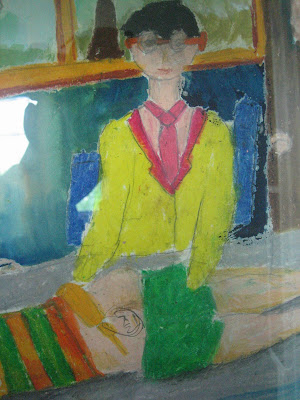
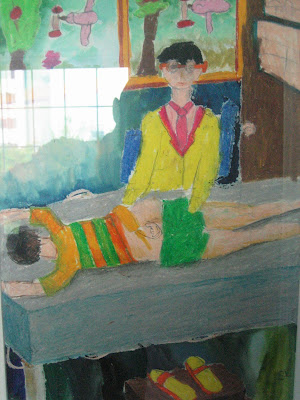
Anyway, the other day I came in to find what is certainly the most amateurish piece of work, but also the most disturbing, in a 'Who made this and why is it hanging on the wall?' kind of way.

Yeah, it's a picture of someone getting an injection in the can. Now that in itself is a little bit weird. First off many of the details are different from an actual injection room. Injection rooms typically don't have huge windows. I have rarely seen a bed in an injection room, and never been asked to lie fully face down to receive an injection. Typically the order is 'Lower your pants', the nurse gives you a few sharp slaps and shoves the needle in, pumps out its contents and you're done, and you didn't feel a thing.

This doctor is giving an injection while sticking his hand up the recipient's shorts. Just stop and look at it, like I am forced to every time I need to sharpen a pencil. Also note that someone has written the Korean word for 'whatevs', jeul (즐, or, if your can't read that, the English letters KIN turned 90 degrees clockwise) on top of the butt. With all of these glaring problems, how did this thing make the cut to go on the wall?

Wednesday, April 18, 2007

Nerdiest graffiti ever


"Kim In-su TOEIC score 900"

TOEIC is the Test of English for International Communication. It's taken by most Koreans looking for good jobs. It's a crammable test whose score does not typically conform to the test-taker's actual English ability. The top score is 990, and 900 is considered a very good score in Korea. But still, graffiti about it? A way down the same street I saw the traditional "penis and testicles" graffiti that has existed since at least Roman times a few weeks ago. Could this be the work of the same artist? An expert in English and anatomy?

Thursday, April 12, 2007

Selecting for the wrong variable

There is a famous anecdote about the search for genes that govern behavior. A scientist wanted to try to breed a type of smart drosophila melanogaster, a common fly used in genetics experiments. He designed a 3D version of the mazes used to test intelligence in rats and mice. He placed one hundred flies in the maze and bred whichever ones came out first, assuming they were the smartest. He did the same with their offspring, finding that with each generation the speed of the fastest flies were increasing. Surely he was on the right track towards developing really smart maze negotiating flies. Finally after several generations he saw a drop-off in the improvement from the last generation and assumed the flies had become as smart as they possibly could be. He took one of these super-smart flies and put it in the maze alone for the first time. Ten, fifteen, twenty minutes passed, but the fly didn't come out. He sent another in after him and the first one quickly flew out.
A little more experimenting showed that in putting so many flies in the maze and breeding the ones that escaped the fastest, he hadn't been selecting for maze-running behavior. Rather, he had been breeding the flies that most wanted to avoid the other flies. He had essentially bred them for antisocial behavior. So, in the pursuit of smart flies, he wound up with crowd-hating flies.

The Korean school year starts in March, and my wife and I were saddled with the task of dividing our two kindergarten classes into two new first grade classes. Although there had been a fairly broad difference in abilities among the children, they were assigned to classes based on their schedules rather than their levels. Of 30 kindergarten students, 16 remained in our first grade classes. We gave the children level tests and combined that information with our own judgment to make the lineups for each class. A1 class would be the children who could read and understood phonics, A2 would be the children who need to focus more and catch up. Both classes have now been running for 6 weeks, and yesterday I came to the discovery that, like the apocryphal scientist in the above story, we have selected for the wrong variable.
We thought we were selecting the students for the speed at which they learn. What I have instead come to realize is that, almost to a man, we have selected students for the presence of a 'good parent'. I define a good parent as someone who spends time with them daily making sure they do homework and maintain an active interest in their child's achievement.
Here's the breakdown:

A1
Simon: Mother frequently consults with my wife about his progress.
Steve: Father studies with him every day.
Penny: Does homework with her mother.
Judy: Mother is an amateur English teacher, they do homework together and she speaks with me regularly.
Manny: Parents have an interest in his education. Does well although not naturally gifted.
Craig: Although he is distracted often, his mother cares a lot about his education.
Lisa: Mother, although busy, checks her homework every day.
Helen: Mother is interested in her progress.
A2
Mark: Started much later than the other children. Parents are fine but don't offer any extra help, which is clearly needed to play catch-up.
Paul: Lisa's twin brother. Despite mother's great interest is not naturally gifted.
Sam: Mother works full time, father recently passed away. Frequently doesn't do homework.
Jessie: Mother is combative, negative and constantly asks me why her daughter is not smart right in front of her.
Sarah: Mother is petty, ditzy and generally unliked. Daughter shares negative personality traits despite sweet general demeanor.
Jason: Very smart boy, but he and his older brother are latchkey kids and their folks are gone all day.
Peter: Not naturally gifted. Parents are aware but unwilling to give him the extra help needed.
June: Good parents and good study habits. Narrowly missed the cut-off point for A1 class, a decision I regret. We are considering moving him up.


So it's clear that, although natural gifts have played a role in our selection, the major factor seems to be the attitude or ability to help of the children's parents. A boy like Jason in A2 would be at the top of A1 with a little help from his mom or dad, while kids like Manny or Craig in A1 would sink to the bottom without good parents. Of course the monkey wrench is Lisa and Paul, fraternal twins with very different abilities, and the saddest case is Sam, who both is not a strong student and only has one very busy parent to look after him. This realization has been very helpful in dealing with A2 class, in that I now know that I can't count on every note that gets sent home to be read and I can't tell the kids to ask their parents for help, because they'll likely get none. Unfortunately the separating of the children has led to vast differences in the pace of study. A1 class is progressing in their new phonics book twice as fast as A2, and there no end to the trend in sight

Sunday, February 11, 2007

The Secretary General of the United Nations cashes in!


I am mildly disgusted that Ban Ki-moon has lent his good name to a book about how to study like the Secretary General called "Study Like an Idiot and Dream Like a Genius" (바보처럼 공부하고 천재처럼 꿈꿔라). Mr. Ban, you're the leader of an international organization with an army vast resources at its disposal, and your main task is to overcome the legacy of corruption left by your predecessor. And so you lend your good name to a quickie book about how to study, which rabidly ambitious parents who don't know any better are going to buy in the millions, read and force their children to read? Why not write a straight autobiography? You are a great man, how could you lower yourself to this level? This book seriously lowers your credibility, and seeing you, who I thought was one of the most respectable and classy politicians in Korea, going straight into the gutter with this exploitative book, I'm disappointed. How would the rest of the world feel if they knew this is the kind of junk you do to make money?

Saturday, February 03, 2007

Boston area Korean raises ruckus about Japanese book

This is a story that is getting a ton of play over here in Korea. A Boston area Korean-American girl was reading "So Far from the Bamboo Grove", a book by Japanese immigrant Yoko Kawashima Watkins about her family's escape from Japanese-occupied Korea at the end of World War 2. The Koreans in the book are represented as a threat to the life of her and other families of Japanese occupying forces. I don't know enough about this topic to speak with authority, but the Korean historians claim that most of the circumstances appearing in Watkins' book are not supported by the fact. Yoko claims that she witnessed rape of Japanese girls by Koreans, that she and her family walked hundreds of miles, travelling at night to escape hostile Korean soldiers. She claims her father attended Oxford, but Oxford has no record of his attendance.
This issue and its response by the media galls me. Whether or not Korea was an out of control place at the time in question, I have no doubt that a young girl whose father is part of an occupying force, undoubtedly prejudiced against the natives and suddenly faced with her distant homeland's loss in a massive war and the collapse of the colonial force in the land where she had been born, would undoubtedly be profoundly effected by her efforts to escape. Everybody knows memory is imperfect, and the book is an unresearched memoir, yet the back cover of the book declares it a true story. Now I don't know if the Korean forces were raping and killing fleeing Japanese women and children, but if I were in the same situation as them, can I truly say I wouldn't be angry enough to threaten the fleeing Japanese? I bet it was scary as hell, shooting or none.
Now, back to history. The book contains a lot of what the fashionable Asian media call "historical distortions'. That seems pretty clear. The issue is that the book is not a history book, it is a memoir and is being taught by English teachers. English teachers universally acknowledge that this is a good book for kids to read, and specifically point to the rape scene as valuable. What Boston public schools decided, and what I think they should have done all along, is instead of accompanying this book with a bunch of half-assed cultural activities folding paper cranes and drinking Arizona Sweetened Green Tea, they should teach the historical background of the book, including the colonization of Korea and the brutality of the Japanese regime in Korea. Then they can take the book with a grain of salt.

Saturday, January 27, 2007

My New Project

I've begun an ambitious new project. I have taken it upon myself to read the popular (in Korea) educational comic book series Monnara Iunnara (Far Country, Neighbor Country), starting with the volume dealing with the American people, and blog about it, sharing the most interesting, accurate, inaccurate, biased and dead-on parts with you. I am keeping an open mind, neither expecting it to be too biased and ridiculous nor too accurate. The illustrations are lively and funny, and the book seems to deal with America's somewhat bumpy history in a well-intentioned manner, but I'll have to read to know for sure. You can check out the new blog here.

Saturday, October 28, 2006

Dropping a thousand eggs out of an airplane onto a field with a frying pan in it.

When I was in junior high I was really into drawing. I've always enjoyed drawing but that was the period in which I considered pursuing art as a career. I filled notebooks with pictures of the things I thought I could draw well and studiously avoided drawing anything that challenged me. To this day when I sit down in front of a piece of blank paper the same things I've been drawing for most of my life come out: rib cages, animals with haunches, wall-eyed people with lolling tongues; in essence, the things that a slightly more creative than average junior high boy would draw. nonetheless, I was under the impression that I had a talent that could somehow support me financially and make the world a better place.
Somewhere along the line I stopped drawing and focused on academics. When I was in junior high and drawing my father would peek over the tops of my notebooks and check out what I was doing, maybe throw in a little gentle ribbing. Over the years since, my father would occasionally bring up drawing out of the blue. "You remember you wanted to be an artist, whatever happened with that? You still drawing?" and other similar comments, which I typically answered by promising him that, no I have no interest in becoming an artist, so don't worry about my future.
But about two weeks ago I was riding on the bus doodling when I had a revelation. My father wasn't teasing me about wanting to be an artist. Having developed a little perspective on the matter, I've discovered that he was perhaps trying to foster my interest in art again, or at least gauge whether it's there. I can imagine having a son of my own who has some artistic dream, and it would do my heart good to come home and see him busy practicing it, whether he had any talent or not.
Having gone to high school in New York state, most of my classmates who thought about going to college naturally gravitated towards New York schools. A lot of my fellow Rocky Point high grads wanted to go to the Fashion Institute of Technology in Manhattan. My sister also considered going there for a time. Because she liked fashion. That's a good reason to pursue a career, perhaps. Just do whatever you like and you'll eventually become good at it, that is true if you have a steely-eyed determination and the keenly honed mind of a scholar, but do you think most of these fashion-loving middle class public school students had the eye of the tiger?
The unfortunate thing about it all is that nobody stopped these kids from pursuing the dream. In fact, many people down the line encouraged their dreams, no matter how poorly founded. If you dream big, you'll change the world, and everything will turn out well if you follow those dreams.
So now it's quite a few years since my classmates made their decisions to pursue their taffeta dreams, and I would reckon that a good number of them dropped out (as did a fair percentage of all my graduating class), and that those that eventually did go into the fashion business created a fairly wide distribution on the scale of success and failure.
Now what if someone, maybe a guidance counsellor or even a parent, had sat down with those kids and said "What are you good at? Maybe fashion isn't your thing, what kind of career would be right for you?"
Well, it probably would've been too late. After 17 years in a permissive culture such as ours, any rationalism of that caliber is simply unheard, invisible to normals.