Any smart advertiser or economist will tell you that it is an absolute necessity to add value and claim value where value is to be claimed. My favorite example of claiming value is at the counter of the all-you-can-eat buffet VIPS, where the same cookies you were just thinking looked kind of cheap when you were in the restaurant are packaged and sold as souvenirs for an obscene $2 for 12 little nothing cookies. They don't sell any cookies, I guarantee, but they remind you that food ain't free, regardless of what you thought when you were on your third plate of tropical salad inside the restaurant.
Claiming valueis not a sin when there's value to claim, but when marketing people start taking blind stabs in the dark, trying to connect people and products that have no business being together, it gets on my nerves. Take gingko biloba. In Korea, Gingko trees grow on the street because they're pretty, and people use their nuts in various traditional remedies. No extravagant health claims are made, and those that are are taken with a grain of salt. No one thinks gingko's a panacea.
This whole adding value thing has gotten out of control, and it takes pleasure out of your lives to think of things we used to enjoy in terms of maximized value. The worst sector for this is without a doubt food. People seem to no longer be able to think of food in terms of taste. Health benefits or ethical concerns are always a factor in people's food purchases. This includes fair trade coffee, foodies and their slow food movement, the Korean 'wellbing' craze and the tendency for all food to be judged by it's fat, vitamin, calorie and mineral content. The inevitable result of all that added value is a decrease in the enjoyment we get from food Rather than the intended added satisfaction of eating healthily or ethically, we are just saddled with the stress of choice.
For more on this, check out "Unhappy Meals" by Michael Pollan, an article about this very topic.
Friday, April 06, 2007

Wednesday, April 04, 2007
Bucheon City Wonmi-dong
On Tuesday mornings I work at a couple of kindergartens in Wonmi-dong. I used the opportunity to take some pictures of the area, which is a confluence of hill, apartment complex, and nice old hillside neighborhood, the good kind. I particularly like the streets in this neighborhood, which are short and twisty, and led to interesting house designs. We start our walk up the hill, which we can see in the background of this picture, by passing the "Great General" grilled pork restaurant on the left and a car garage - beauty parlor - mom and pop shop strip on the right.
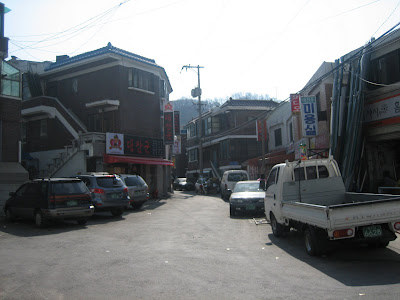
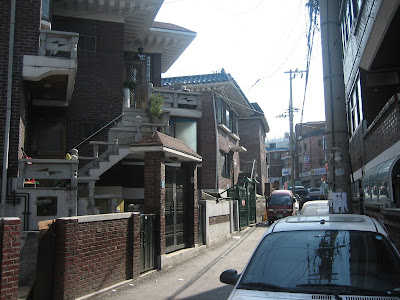
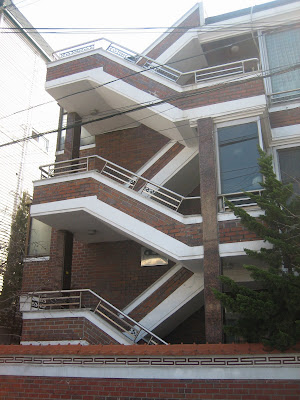
This is what I mean by twisty little roads with cool architecture. I love these old Korean houses, with balconies, gates and stairways latched onto their breadbox bodies like ivy. I tried very hard to find a stairway that actually incorporates the front gate into its design, but this was the best I could do.
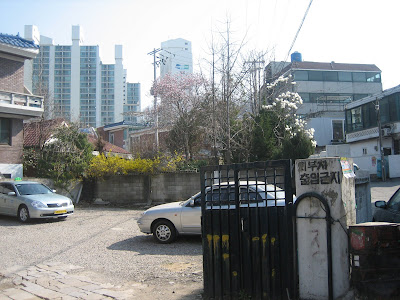
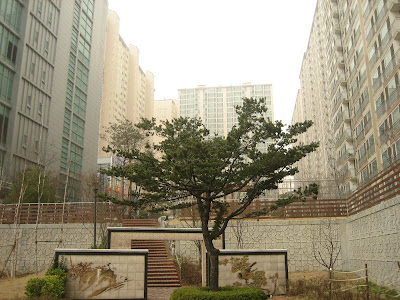
This neighborhood is wedged between two apartment blocks. The one in the background here is to the north. Somehow people here respond to empty space in one of two ways, bleak parking spaces or flowering trees.
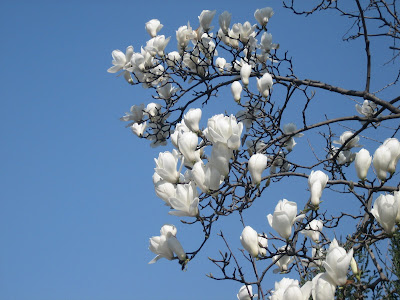
I know I am not the first or last person, and not even the only one this spring to take a picture of a snow whiteacaciaacacias magnolias against a cloudless sky.
Look at this little wedge of a building, with a blue flatbed to the right and a red and cream motorcycle to the right. The store in the building is called the 'Princess Supermarket'. Think for a moment about that sweet time when the owner of the store called up the sign maker and proudly told him the name he wanted, maybe looking down at his smiling daughter of beloved wife. That is so precious. In the background, houses where people live sweet lives too, but where's the heart (정)?

Nothing significant here, I just really like those stairs.
After about a ten minute walk the neighborhood comes to a dead stop and we are confronted with a tunnel under a highway.

We come out on the other end and find ourself at the base of Wonmi mountain. To the left there's a little junk yard of some kind, but on such a beautiful morning you can't let that get you down.

Up a stairway and we can look back down on the neighborhood we just crossed through and the highway we were just tunneling under. One more blue flatbed, too. The skyline in the back is defined by the new We've The State development that I've discussed before.

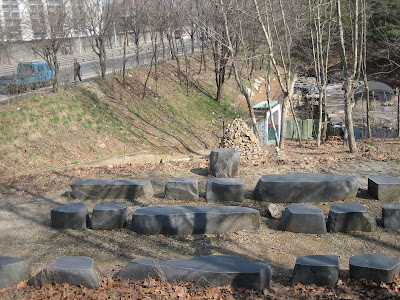
Turning to the right to look back down on the tunnel that we came through, an open air amphitheater that I imagine has never been used. That is not the same blue flatbed, by the way.
I didn't have enough time to go up the mountain, that'll have to wait for next time. coming back down through the tunnel I ran into a crew of hiking ajummas, wearing their masks because the previous day had been a particularly serious yellow dust day. This day, however, was clear as crystal.
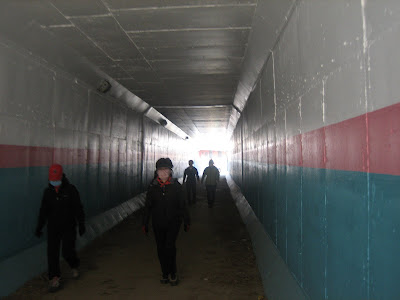
Full disclosure: I wear a mask on yellow dust days too.

Coming back down: count the stairways.

I found myself up on a retaining wall that gave a really pretty view of some houses, with their faux-traditional (fauxditional?) roofs and flowers in bloom.

Moreacacias magnolias, now with HOF!
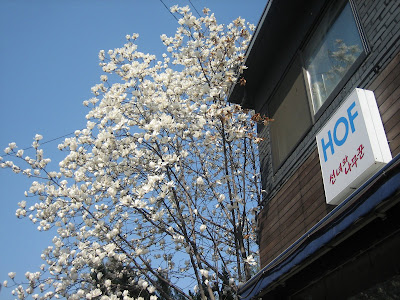
If you don't know, these flowers have the weirdest petals imaginable. They're heavy and thick, and it's like a flower made of banana leaves. Stepping on these flowers is similar in sensation, I imagine, to stepping on a piece of raw bacon. Also tonight my students told me that these flowers are both edible and delicious. I'll be sure to try them out as soon as possible.
(update: In fact my students told me that acacias are sweet and delicious, and I assumed that these were acacias when in fact the flowers in question are magnolias. Magnolias, incidentally, taste like that pink pickled ginger that you get with your sushi.

Now we're out of the neighborhood, in the interstices between the apartment block and the neighborhood. It's a bit of an ugliness watershed, for whatever reason.

After crossing the ugly road I find myself at the gates of Wonmi Market. The white sign says "Fire Prevention done together, bright tomorrow where we laugh together." I am glad I am not a professional translator.

I still don't have the gall to just take pictures of total strangers at work, so my pictures from inside the market are conspicuously unpopulated. That and it is only around ten in the morning. The markets really don't get hopping until late in the morning.

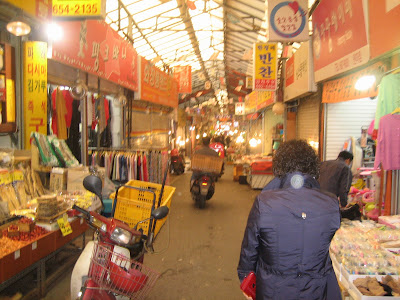
The motorcycle in this picture just buzzed past this lady and me. I am anesthetized to this sort of thing, and the lady in front of me paid it no mind. But you, with your luxurious civic institutions of common courtesy, would be red-faced with anger. On the right: a rice cake (떡) shop.
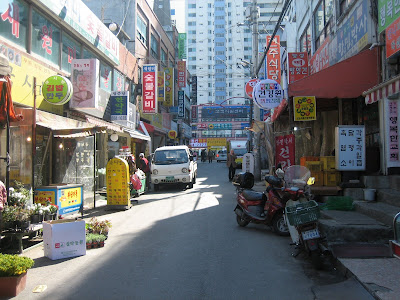
Coming out of the covered part of the market, but it's still pretty mercsntile.
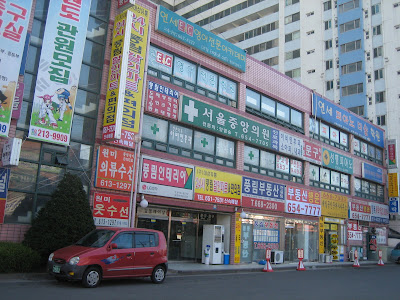
This is how apartment dwellers raised on going to the market get by: they stick the whole market into a building. It's garish, but incredibly convenient.
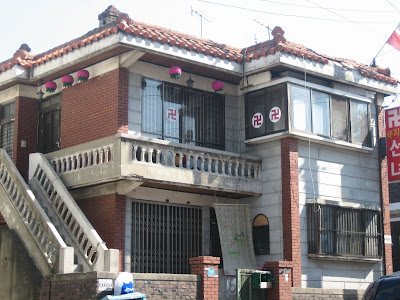
Here's a house gone Buddhist temple. Notice the swastikas and lotus lamps.
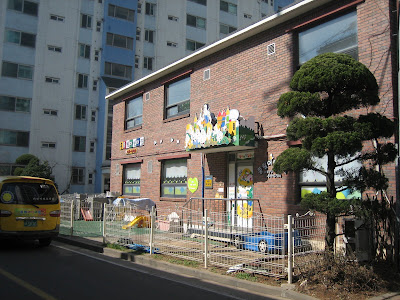
Here's a house turned preschool. That's where I'm headed for an hour of kindy.

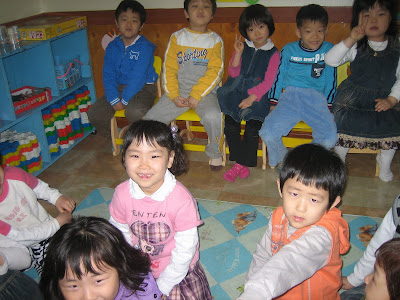
I've been teaching these guys for over a year, but only once a week. That means they remember almost nothing that I teach them. But I still like them.
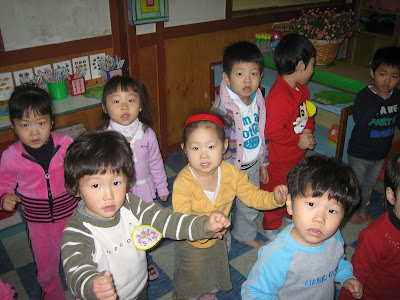
Here's the next gig, this one in one of the administrative buildings within the apartment complex converted into a kindergarten.
These guys I only see for twenty minutes twice a month. They don't even have a name for me, I'm just the nameless English teacher who makes them do the coconut dance to the song "Do the Monkey".
On my way across town, I decided to finally get a picture of Bucheon's own Kenny-G Coffee and Hof. I know they say the Kenny-G Coffee and Hof in Manhattan is the best one, but I think this one holds its own.

I would love for someone to tell me who the people in this sign are supposed to be. I think they are Sarah Jessica Parker, Ashton Kutcher and Brittany Murphy, if all of them were unfrozen cavemen.

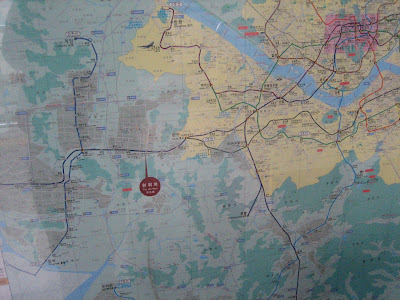
Here you can get a general Idea of where Bucheon is. The pink area is the downtown area of Seoul, the yellow area is Seoul, and the burgundy bubble points to Bucheon station. The grey splotch on the left is Incheon.
I looked out the window while having lunch and caught sight of where they park the street stalls during the day. It's awesome to me to think that something so humble can be unfurled into a sort of cultural ark every night.

Now I'm off at my steady job. This is my first class of the day there. These guys are a smart bunch of first graders who are pretty good at English, by their neighborhood's standards. Like in most such English schools, we give our kids English names. From left: Steve, Simon, Craig, Manny, Judy, Lisa (rear), Helen, and Penny.

Corn Ice Cream isn't the only great corn product in Korea. Here's roast corn tea, or as I like to call it, popcorn juice.

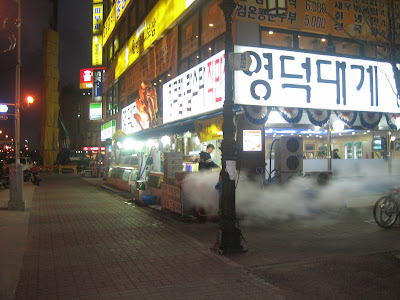
On my way home I caught these kids frolicking in the steam from this king crab restaurant's outdoor steamer. It smelled amazing.
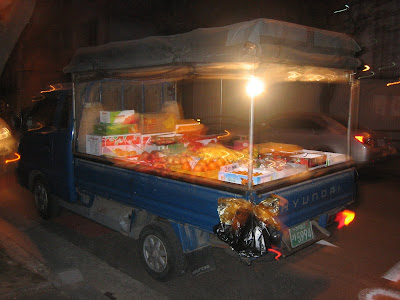
What could be better before going home for the night than illuminated mobile fruit. Doesn't that look delicious? Deliciously convenient. Hanging from the left rear corner of the truck are the plastic bags they wrap up the fruit in for the customers. This truck trolls the street playing a recording of what they have in stock. "honey apples, three for five thousand, honey apples, three for five thousand, chamwe melons, two for three thousand." If you happen to not want to buy fruit, however, this is likely to be an unwelcome aural intrusion into your home at the TV hour, but if you've lived here long enough, you're inured to it.
This is what I mean by twisty little roads with cool architecture. I love these old Korean houses, with balconies, gates and stairways latched onto their breadbox bodies like ivy. I tried very hard to find a stairway that actually incorporates the front gate into its design, but this was the best I could do.
This neighborhood is wedged between two apartment blocks. The one in the background here is to the north. Somehow people here respond to empty space in one of two ways, bleak parking spaces or flowering trees.
I know I am not the first or last person, and not even the only one this spring to take a picture of a snow white
Look at this little wedge of a building, with a blue flatbed to the right and a red and cream motorcycle to the right. The store in the building is called the 'Princess Supermarket'. Think for a moment about that sweet time when the owner of the store called up the sign maker and proudly told him the name he wanted, maybe looking down at his smiling daughter of beloved wife. That is so precious. In the background, houses where people live sweet lives too, but where's the heart (정)?
Nothing significant here, I just really like those stairs.
After about a ten minute walk the neighborhood comes to a dead stop and we are confronted with a tunnel under a highway.
We come out on the other end and find ourself at the base of Wonmi mountain. To the left there's a little junk yard of some kind, but on such a beautiful morning you can't let that get you down.
Up a stairway and we can look back down on the neighborhood we just crossed through and the highway we were just tunneling under. One more blue flatbed, too. The skyline in the back is defined by the new We've The State development that I've discussed before.
Turning to the right to look back down on the tunnel that we came through, an open air amphitheater that I imagine has never been used. That is not the same blue flatbed, by the way.
I didn't have enough time to go up the mountain, that'll have to wait for next time. coming back down through the tunnel I ran into a crew of hiking ajummas, wearing their masks because the previous day had been a particularly serious yellow dust day. This day, however, was clear as crystal.
Full disclosure: I wear a mask on yellow dust days too.
Coming back down: count the stairways.
I found myself up on a retaining wall that gave a really pretty view of some houses, with their faux-traditional (fauxditional?) roofs and flowers in bloom.
More
If you don't know, these flowers have the weirdest petals imaginable. They're heavy and thick, and it's like a flower made of banana leaves. Stepping on these flowers is similar in sensation, I imagine, to stepping on a piece of raw bacon. Also tonight my students told me that these flowers are both edible and delicious. I'll be sure to try them out as soon as possible.
(update: In fact my students told me that acacias are sweet and delicious, and I assumed that these were acacias when in fact the flowers in question are magnolias. Magnolias, incidentally, taste like that pink pickled ginger that you get with your sushi.
Now we're out of the neighborhood, in the interstices between the apartment block and the neighborhood. It's a bit of an ugliness watershed, for whatever reason.
After crossing the ugly road I find myself at the gates of Wonmi Market. The white sign says "Fire Prevention done together, bright tomorrow where we laugh together." I am glad I am not a professional translator.
I still don't have the gall to just take pictures of total strangers at work, so my pictures from inside the market are conspicuously unpopulated. That and it is only around ten in the morning. The markets really don't get hopping until late in the morning.
The motorcycle in this picture just buzzed past this lady and me. I am anesthetized to this sort of thing, and the lady in front of me paid it no mind. But you, with your luxurious civic institutions of common courtesy, would be red-faced with anger. On the right: a rice cake (떡) shop.
Coming out of the covered part of the market, but it's still pretty mercsntile.
This is how apartment dwellers raised on going to the market get by: they stick the whole market into a building. It's garish, but incredibly convenient.
Here's a house gone Buddhist temple. Notice the swastikas and lotus lamps.
Here's a house turned preschool. That's where I'm headed for an hour of kindy.
I've been teaching these guys for over a year, but only once a week. That means they remember almost nothing that I teach them. But I still like them.
Here's the next gig, this one in one of the administrative buildings within the apartment complex converted into a kindergarten.
These guys I only see for twenty minutes twice a month. They don't even have a name for me, I'm just the nameless English teacher who makes them do the coconut dance to the song "Do the Monkey".
On my way across town, I decided to finally get a picture of Bucheon's own Kenny-G Coffee and Hof. I know they say the Kenny-G Coffee and Hof in Manhattan is the best one, but I think this one holds its own.
I would love for someone to tell me who the people in this sign are supposed to be. I think they are Sarah Jessica Parker, Ashton Kutcher and Brittany Murphy, if all of them were unfrozen cavemen.
Here you can get a general Idea of where Bucheon is. The pink area is the downtown area of Seoul, the yellow area is Seoul, and the burgundy bubble points to Bucheon station. The grey splotch on the left is Incheon.
I looked out the window while having lunch and caught sight of where they park the street stalls during the day. It's awesome to me to think that something so humble can be unfurled into a sort of cultural ark every night.
Now I'm off at my steady job. This is my first class of the day there. These guys are a smart bunch of first graders who are pretty good at English, by their neighborhood's standards. Like in most such English schools, we give our kids English names. From left: Steve, Simon, Craig, Manny, Judy, Lisa (rear), Helen, and Penny.
Corn Ice Cream isn't the only great corn product in Korea. Here's roast corn tea, or as I like to call it, popcorn juice.
On my way home I caught these kids frolicking in the steam from this king crab restaurant's outdoor steamer. It smelled amazing.
What could be better before going home for the night than illuminated mobile fruit. Doesn't that look delicious? Deliciously convenient. Hanging from the left rear corner of the truck are the plastic bags they wrap up the fruit in for the customers. This truck trolls the street playing a recording of what they have in stock. "honey apples, three for five thousand, honey apples, three for five thousand, chamwe melons, two for three thousand." If you happen to not want to buy fruit, however, this is likely to be an unwelcome aural intrusion into your home at the TV hour, but if you've lived here long enough, you're inured to it.
The eventual result of ubiquitous video
If the Youtube-style video sharing technology remains legal and in its current form, eventually we are going to have to become completely comfortable with the full range of emotions and actions available to human beings.
That means accepting that sometimes good people say bad things, or change their minds or have bad moods. That means accepting that sometimes smart people do dumb things, and that effective and committed people have had changes of heart in the past. Most of all it means accepting that nobody's perfect and that sometimes you just have to let some things slide. Rosie O'Donnell is not racist for saying 'ching chong ching', John Edwards is not featherweight just because he sometimes preens for an uncomfortably long time in front of the mirror, and Karl Rove is not an A-hole because he participated in a rap.
The way I see it our two options are to grow up or allow our whole society to turn into junior high school.
That means accepting that sometimes good people say bad things, or change their minds or have bad moods. That means accepting that sometimes smart people do dumb things, and that effective and committed people have had changes of heart in the past. Most of all it means accepting that nobody's perfect and that sometimes you just have to let some things slide. Rosie O'Donnell is not racist for saying 'ching chong ching', John Edwards is not featherweight just because he sometimes preens for an uncomfortably long time in front of the mirror, and Karl Rove is not an A-hole because he participated in a rap.
The way I see it our two options are to grow up or allow our whole society to turn into junior high school.
Whimia, the White man in Africa
A while back I posted about the Magical Black Man of American pop culture, and the one and only Boonvillian asked if this was at all related to the star of films featuring a white protagonist in Africa, White Man In Africa. At the time I had nothing to say about the White Man In Africa (henceforth the mythical creature-sounding Whimia). I have since realized that the Whimia Africanus is a closely related cousin of one of my own favorite characters, the Whimia Asiaticus.
The Whimia in all its forms is intrinsically linked to colonialism. I got my own first major exposure to the Asiatic Whimia through the works of Clockwork Orange author Anthony Burgess. In high school his series The Long Day Wanes fascinated me. His characters, British, Chinese, Malay, Indian, and Indonesian, never seemed like stereotypes. When ever he matter-of factly broad-brushed a whole group of people — Chinese widows generally turn to lesbianism, for example — It always felt like these details were just something you'd have to be there to know. Like if I said "Koreans spit on the street," the natural American tendency is to reject all such blanket statements and say "well surely not all Koreans spit on the street", which immediately makes a value judgment about the observation and is much more judgmental than simply bowing to superior firsthand knowledge. But reading Burgess, this type of observation is made with such authority as to make them seem natural, and that somehow circumvents the reader's impulse to judge.
Naturally Burgess is the exception to the rule, in that he is a brilliant writer. Most writers are decidedly not brilliant. So why the Whimia?
For one thing, it's hard to write characters from a culture you don't know well convincingly. That's why throughout the interactions with the West and the rest the West's story has been told decidedly better than the rest. Natives tend to fall into the same general patterns; noble or savage, conniving or sniveling, selfless savior or soulless head-shrinker, but always simple. For most writers they have a choice between the following two options.
It's hard to write about fully fleshed out people. I take it there are two main groups of writers, those who write about events and places and those who write about emotions. The ones that write about events generally only like to focus on one or two real characters and let the places and events form the rest of the story. Thus you wind up with a story about a guy somewhat like the writer in a place that the writer may or may not know well, surrounded by colorful human props. The ones who write about emotions generally don't care too much where their story takes place, don't want the backdrop to get in the way of the feelings, or want to have a cast of characters that the audience will be able to relate to. This usually means a bunch of upper middle class Americans.
What kind of people are these Whimias? They come in a few main types. There's the man gone native, like Kurtz in Apocalypse now, mad on the power of colonialism. That's not the only way to go native though. Bob Hoskins in The Sleeping Dictionary went sexually native, which is another big trope that stems from colonialism. 'If you succumb to the supple temptations of a native girl you'll wind up fathering a sexy halfbreed daughter who walks around in banana leaves' is usually the lesson of these movies. You can also forget about your own culture, which was apparently a constant worry for the British Empire characters in Burgess' books, who were constantly forgetting English and finding themselves siding with the natives.
Another common type of Whimia is the do-gooder. The do-gooder is usually a war correspondent, aid worker, or some such. This is usually the best way to shoehorn a white woman(i.e. Angelina Jolie) into a movie about Asia or Africa. The do-gooders usually care deeply about the natives swarming around them, but have no deep relationships with them at all because they have a paternalistic protective attitude towards them. The main natives in these movies are usually translators or baggage handlers for these humanitarians.
The last major type of Whimia that you see is the outcast of the West. This is Michael Douglas' character in The Ghost and the Darkness, who left America after the Civil War to devote the rest of his life to bloody carnage. This also applies to Tom Cruise in The Last Samurai. They went out in search of something that their modern world had left behind.
We could probably sum up the Whimia as either headed into the wild to bring the light of modernity or fleeing some endemic problem with their own native land. When they get there they either go mad or not. Also all white women who go to non-white countries are either aid workers or married to British civil servants. If they're aid workers they have passionate love affairs with noble white guys, and if their wives of British civil servants they suffer the indignity of watching their husbands have the hottest sex of their lives with girls in banana-leaf skirts.
The Whimia in all its forms is intrinsically linked to colonialism. I got my own first major exposure to the Asiatic Whimia through the works of Clockwork Orange author Anthony Burgess. In high school his series The Long Day Wanes fascinated me. His characters, British, Chinese, Malay, Indian, and Indonesian, never seemed like stereotypes. When ever he matter-of factly broad-brushed a whole group of people — Chinese widows generally turn to lesbianism, for example — It always felt like these details were just something you'd have to be there to know. Like if I said "Koreans spit on the street," the natural American tendency is to reject all such blanket statements and say "well surely not all Koreans spit on the street", which immediately makes a value judgment about the observation and is much more judgmental than simply bowing to superior firsthand knowledge. But reading Burgess, this type of observation is made with such authority as to make them seem natural, and that somehow circumvents the reader's impulse to judge.
Naturally Burgess is the exception to the rule, in that he is a brilliant writer. Most writers are decidedly not brilliant. So why the Whimia?
For one thing, it's hard to write characters from a culture you don't know well convincingly. That's why throughout the interactions with the West and the rest the West's story has been told decidedly better than the rest. Natives tend to fall into the same general patterns; noble or savage, conniving or sniveling, selfless savior or soulless head-shrinker, but always simple. For most writers they have a choice between the following two options.
- The sweat on village chief Madinke's rippling chest glinted in the light of the setting sun. He looked upon all that the white man, John Prester, had brought to his people; running water; mosquito nets; the good book that his son was learning to decipher with the blue eyed spirit from across the big waters; and of course cricket. Although he couldn't make out just what was going on, he sensed that it was something good. The big man sighed a sigh of relief, as if to say "It's all in good hands now."
- Although Madinke knew that the presence of the Englishman had placed him in the bad graces of the Kubwiya tribe across the river, and that the Kundate tribe had itself a black robed missionary and seemed to be allying themselves with the Spanish, he felt confident that in the societal upheavals he could see going on all around him it was in his best interest to allow John Prester to teach his son, and yet still he worried that he had aligned himself with the wrong side. There were those among the young upstarts in the village who buckled under the presence of the white man, and others who suggested that Madinke follow the lead of the Kundate and cast off the Englishman for the black robed missionary. Nonetheless Madinke thought himself unable to turn back on his decision to allow Prester in. He felt in himself that powers both under his nose and far afield and all well beyond his control were at work.
It's hard to write about fully fleshed out people. I take it there are two main groups of writers, those who write about events and places and those who write about emotions. The ones that write about events generally only like to focus on one or two real characters and let the places and events form the rest of the story. Thus you wind up with a story about a guy somewhat like the writer in a place that the writer may or may not know well, surrounded by colorful human props. The ones who write about emotions generally don't care too much where their story takes place, don't want the backdrop to get in the way of the feelings, or want to have a cast of characters that the audience will be able to relate to. This usually means a bunch of upper middle class Americans.
What kind of people are these Whimias? They come in a few main types. There's the man gone native, like Kurtz in Apocalypse now, mad on the power of colonialism. That's not the only way to go native though. Bob Hoskins in The Sleeping Dictionary went sexually native, which is another big trope that stems from colonialism. 'If you succumb to the supple temptations of a native girl you'll wind up fathering a sexy halfbreed daughter who walks around in banana leaves' is usually the lesson of these movies. You can also forget about your own culture, which was apparently a constant worry for the British Empire characters in Burgess' books, who were constantly forgetting English and finding themselves siding with the natives.
Another common type of Whimia is the do-gooder. The do-gooder is usually a war correspondent, aid worker, or some such. This is usually the best way to shoehorn a white woman(i.e. Angelina Jolie) into a movie about Asia or Africa. The do-gooders usually care deeply about the natives swarming around them, but have no deep relationships with them at all because they have a paternalistic protective attitude towards them. The main natives in these movies are usually translators or baggage handlers for these humanitarians.
The last major type of Whimia that you see is the outcast of the West. This is Michael Douglas' character in The Ghost and the Darkness, who left America after the Civil War to devote the rest of his life to bloody carnage. This also applies to Tom Cruise in The Last Samurai. They went out in search of something that their modern world had left behind.
We could probably sum up the Whimia as either headed into the wild to bring the light of modernity or fleeing some endemic problem with their own native land. When they get there they either go mad or not. Also all white women who go to non-white countries are either aid workers or married to British civil servants. If they're aid workers they have passionate love affairs with noble white guys, and if their wives of British civil servants they suffer the indignity of watching their husbands have the hottest sex of their lives with girls in banana-leaf skirts.
Tuesday, April 03, 2007
Cool things Korean (part 1)
There are times when those living in Korea are faced with the question "What am I doing here?" One of the best examples of such a time is during the early spring "yellow dust" season during which Korea is blanketed with, um, yellow dust from China's recently deforested desert region. Thanks China!
1. Corn Ice Cream
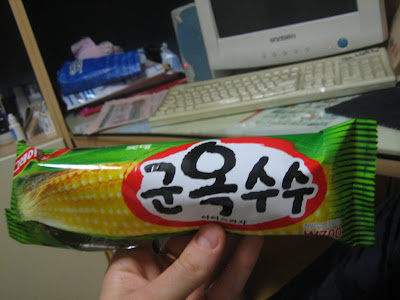
I'm talking about the Gunoksusu corn ice cream bar. a thick tube of corn ice cream with real corn niblets churned right in, wrapped in a thin layer of chocolate and ensconced in a soft corn-shaped wafer, giving it a strong resemblance to an actual ear of corn. Here's the wrapper
And here's a cross-section.
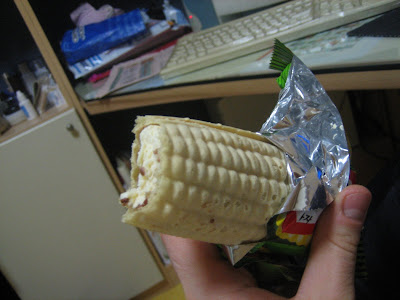
Unfortunately I was not able to coax a niblet to the surface to be photographed, but imagine a soft, chewy piece of corn in chilly corny ice cream. Makes all that severe respiratory risk worthwhile.
2. T Money
Actually the whole concept of proximity cards. So you want to ride the bus or subway? Get yourself a transit card, either a credit card with transit card capabilities or a debit transit card, and you never have to take it out of your wallet or purse. When you go through the turnstyle or get in the bus, just slap your whole wallet or bag onto the T Money thingy and it will deduct the appropriate amount from your account or charge you. Better still, when you get off the bus to transfer, slap that puppy on there again and it'll automatically discount your transfer.
But the single coolest thing about the whole proximity technology is that it's not limited to cards.
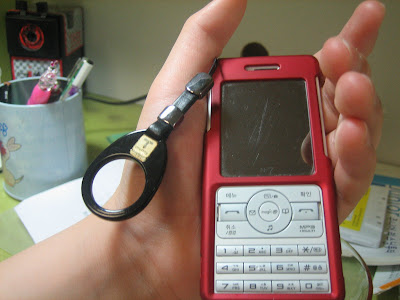
That's my student Ucheol's phone, and the little black cell phone bauble to the left is his T Money card. See the little gold T on there? It's smaller than a ring pop for crying out loud!
I was taking a picture of the tree but check out that yellow dust. This was ten o'clock Sunday morning.
And so when faced with media hysteria about yellow dust, I am left seeking justifications for my continued presence in a country in eminent danger of being completely plowed under by fine particulate matter. Here's what I came up with.1. Corn Ice Cream
I'm talking about the Gunoksusu corn ice cream bar. a thick tube of corn ice cream with real corn niblets churned right in, wrapped in a thin layer of chocolate and ensconced in a soft corn-shaped wafer, giving it a strong resemblance to an actual ear of corn. Here's the wrapper
And here's a cross-section.
Unfortunately I was not able to coax a niblet to the surface to be photographed, but imagine a soft, chewy piece of corn in chilly corny ice cream. Makes all that severe respiratory risk worthwhile.
2. T Money
Actually the whole concept of proximity cards. So you want to ride the bus or subway? Get yourself a transit card, either a credit card with transit card capabilities or a debit transit card, and you never have to take it out of your wallet or purse. When you go through the turnstyle or get in the bus, just slap your whole wallet or bag onto the T Money thingy and it will deduct the appropriate amount from your account or charge you. Better still, when you get off the bus to transfer, slap that puppy on there again and it'll automatically discount your transfer.
But the single coolest thing about the whole proximity technology is that it's not limited to cards.
That's my student Ucheol's phone, and the little black cell phone bauble to the left is his T Money card. See the little gold T on there? It's smaller than a ring pop for crying out loud!
Monday, April 02, 2007
Ssangyong Automotive: Purveyors of Eye Poison (part 1)
 Feast your eyes on the Ssangyong Actyon, one of the ugliest cars in God's creation. Some say that the most surefire way for a country to meet its Kyoto Protocol-mandated carbon emissions cap is to order people to drive Actyons.
 Even a couple of hooched out flooziebots can draw the eye to the mind-entardening lines of the Actyon.
Here's a picture from a Chinese site that seems to be a sort of optical illusion to anyone who knows what the car really looks like.
 The only people not afraid to show the car's perfectly horizontal full side view are the manufacturers, Ssangyong. These are also the only people who never have to sell the car directly to the consumer.
Some quotes about Actyon from others:
BKK Autos - "Actyon is ugly, impractical, and feels cheap."
Broken Fin - "Ssangyong Actyon is so ugly that I feel that it is my moral obligation to inform the world of this catastrophe in automotive design."
Car Today (South Africa) - "Korea's SsangYong, the maker of spectacularly offensive vehicles like the Stavic, Kyron, and to a lesser extent Rexton II, has with the unveiling of the Actyon Sports double cab at the Auto Africa Expo, unleashed yet another automotive masterpiece onto the local market."
That last one was actually about the Actyon Sports, which is even more depressing:

Sunday, April 01, 2007
Overcorrection
I was just watching a really useful video done by the New York Times about how to make the Korean pancake Pajun (rhyme's with 'hot sun') and I got to thinking about overcorrection. Overcorrection is an interesting little process that happens when people learn a foreign language or try to use a grammatical construction in their own language that they're not comfortable with.
The classic English example is when people say something like "Jack gave the books to Danny and I." Many people grow up saying 'Danny and me' in sentences such as 'Danny and me went to the movies.', but this, of course, is wrong, according to the grammar books it should be 'Danny and I went to the movies.' because Danny went and I went. So people who have to struggle to talk this way learn the pseudo-rule 'always say " . . . and I"'. In the first sentence above, we should say "Jack gave the books to Danny and me." He gave one to Danny and one to me, not 'to I'. Thus people overcorrect their 'and me's to oblivion, even when 'and me' is correct.
In a foreign language context things get much weirder. I'll use Koreans learning English because I know about it all too well. When English words ending with 'p', 't', 'k', and 's' sounds are transliterated into Korean a sound similar to the 'ooh' sound is appended to the end of the word. So to a Korean 'help' is pronounces 'helpu'. In learning English they learn early on that when a Konglish (borrowed English) word has an 'ooh' at the end you make it into real English by dropping the 'ooh'. This works fine as a general rule:
테스트 (te-su-tu) >test
헤드 (he-du) > head
텐트 (ten-tu) > tent
But what about 'issue' and 'tissue'? You guessed it, scads of Koreans pronounce these words 'ish' and 'tish'. Same problem with any instance of 's' precending 'u', so you get people pronouncing 'soup' as 'spuh' and 'superman' as 'sperman'.
Furthermore, the 'f', 'v', and 'z' sounds are absent in Korean. So 'Jew' and 'zoo' are both pronounced 'joo', 'wife' and 'wipe' are both pronounced 'wipe', and God help anyone coming to Korea named Pat, whose name, people will assume, is 'Fat'. The same overcorrection process occurs here.
텔레폰 (tel-le-pon) > telephone
프론트 (pu-ron-tu) > front
파이브 (pa-i-bu) > five
티브이 (ti-bu-i) > TV
존 (jon) > zone, John
So of course here people say to themself "'p', 'b' and 'j' (no pun intended) are Korean sounds. Avoid them in favor of 'f', 'v' and 'z'." People overuse these sounds like crazy to make their Engish sound good, instead of really focusing on their listening and speaking skills enough to distinguish the two sounds. When you put the 'ooh' problem and the PB&J problem together with other poor pronunciations you can get exceedingly weird mispronunciations, like 'shamf' for 'shampoo' and 'farry' for 'party'.
The reason this comes up is because the cook in the video above does an English-to-Korean pseudo-overcorrection that my dad always does. My father has been to Korea twice, and knows exactly three Korean words. The first is 'kimchi', naturally, and the other two are 'soju' and 'ajumma' which mean, to him 'deceptively mild alcohol that Koreans want him to drink a lot of' and 'middle aged tough permed lady or sexy lady in business suit'. The thing is he cannot resist the temptation to proounce these words with the frenchy 'zh' sound of the words 'pleasure' and 'measure', so it's 'sozhu' and 'azhumma' for him. Classic overcorrection, except that the Korean language doesn't even have the 'zh' sound, my father, and the guy in the video, just think it should. 10 seconds in the cook pronounced pajun respectably as pajohn, but 2:10 minutes in, something deep in his brain tells him "'j' sound too familiar to be right" and he says 'pazhan'. It's an interesting thing about humans that we make these little simple rules to deal with the world and stick with them even when they're too simple to possibly be right.
The classic English example is when people say something like "Jack gave the books to Danny and I." Many people grow up saying 'Danny and me' in sentences such as 'Danny and me went to the movies.', but this, of course, is wrong, according to the grammar books it should be 'Danny and I went to the movies.' because Danny went and I went. So people who have to struggle to talk this way learn the pseudo-rule 'always say " . . . and I"'. In the first sentence above, we should say "Jack gave the books to Danny and me." He gave one to Danny and one to me, not 'to I'. Thus people overcorrect their 'and me's to oblivion, even when 'and me' is correct.
In a foreign language context things get much weirder. I'll use Koreans learning English because I know about it all too well. When English words ending with 'p', 't', 'k', and 's' sounds are transliterated into Korean a sound similar to the 'ooh' sound is appended to the end of the word. So to a Korean 'help' is pronounces 'helpu'. In learning English they learn early on that when a Konglish (borrowed English) word has an 'ooh' at the end you make it into real English by dropping the 'ooh'. This works fine as a general rule:
테스트 (te-su-tu) >test
헤드 (he-du) > head
텐트 (ten-tu) > tent
But what about 'issue' and 'tissue'? You guessed it, scads of Koreans pronounce these words 'ish' and 'tish'. Same problem with any instance of 's' precending 'u', so you get people pronouncing 'soup' as 'spuh' and 'superman' as 'sperman'.
Furthermore, the 'f', 'v', and 'z' sounds are absent in Korean. So 'Jew' and 'zoo' are both pronounced 'joo', 'wife' and 'wipe' are both pronounced 'wipe', and God help anyone coming to Korea named Pat, whose name, people will assume, is 'Fat'. The same overcorrection process occurs here.
텔레폰 (tel-le-pon) > telephone
프론트 (pu-ron-tu) > front
파이브 (pa-i-bu) > five
티브이 (ti-bu-i) > TV
존 (jon) > zone, John
So of course here people say to themself "'p', 'b' and 'j' (no pun intended) are Korean sounds. Avoid them in favor of 'f', 'v' and 'z'." People overuse these sounds like crazy to make their Engish sound good, instead of really focusing on their listening and speaking skills enough to distinguish the two sounds. When you put the 'ooh' problem and the PB&J problem together with other poor pronunciations you can get exceedingly weird mispronunciations, like 'shamf' for 'shampoo' and 'farry' for 'party'.
The reason this comes up is because the cook in the video above does an English-to-Korean pseudo-overcorrection that my dad always does. My father has been to Korea twice, and knows exactly three Korean words. The first is 'kimchi', naturally, and the other two are 'soju' and 'ajumma' which mean, to him 'deceptively mild alcohol that Koreans want him to drink a lot of' and 'middle aged tough permed lady or sexy lady in business suit'. The thing is he cannot resist the temptation to proounce these words with the frenchy 'zh' sound of the words 'pleasure' and 'measure', so it's 'sozhu' and 'azhumma' for him. Classic overcorrection, except that the Korean language doesn't even have the 'zh' sound, my father, and the guy in the video, just think it should. 10 seconds in the cook pronounced pajun respectably as pajohn, but 2:10 minutes in, something deep in his brain tells him "'j' sound too familiar to be right" and he says 'pazhan'. It's an interesting thing about humans that we make these little simple rules to deal with the world and stick with them even when they're too simple to possibly be right.
Subscribe to:
Posts (Atom)
